Bofors Scandal Investigation
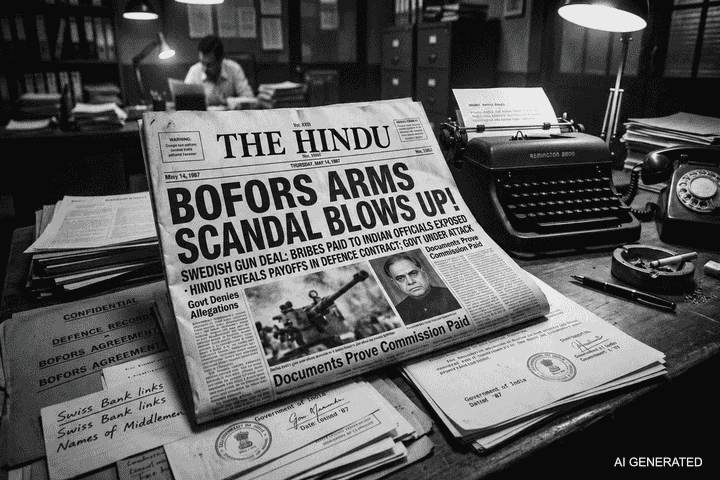
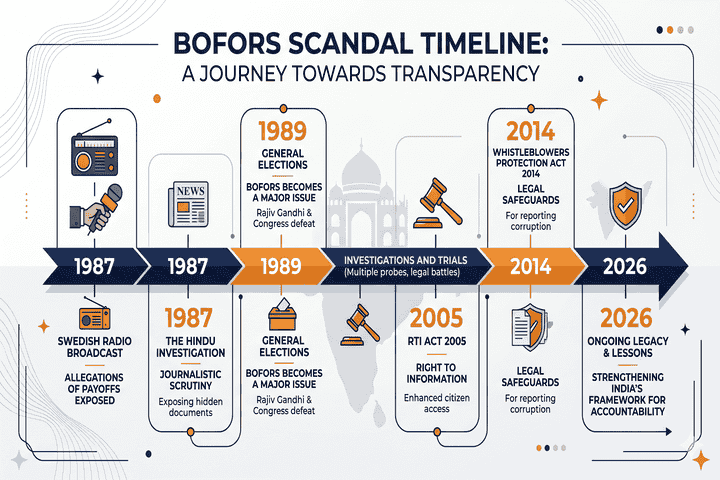
In April 1987, Swedish Public Radio broadcast allegations of kickbacks in India’s purchase of Bofors howitzers — and then went silent. What followed over the next two years was one of the most consequential investigative journalism exercises in post-Independence India, one that reshaped the political landscape, brought down a government, and permanently altered the standards by which Indian newsrooms measured accountability reporting.
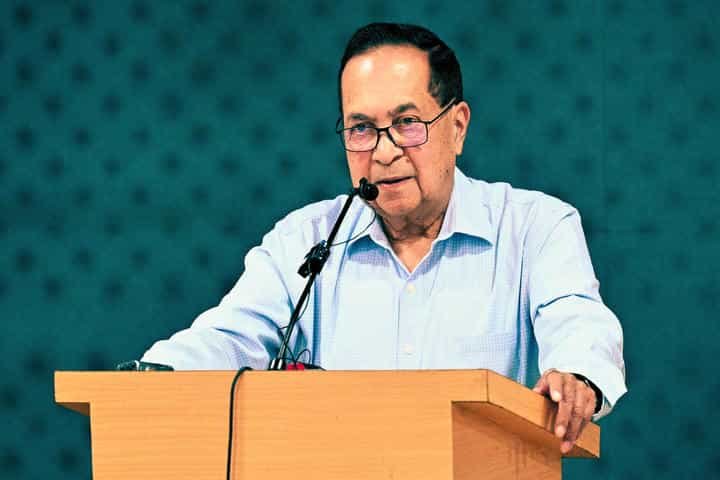
The investigation, led by N. Ram and a core team at The Hindu — including Chitra Subramaniam, Manoj Joshi, Malini Parthasarathy, and V.K. Ramachandran — was not a dramatic scoop delivered in a single edition. It was a methodical, document-driven, multi-installment inquiry that drew on hundreds of primary source materials, verified every factual claim against multiple checkpoints, and held itself to a standard of fairness that even extended to publicly correcting its own errors on the front page.
For students of journalism and mass communication, the Bofors scandal investigation is not merely a historical episode. It is a master class in investigative methodology, source management, editorial ethics, and the tension between journalistic standards of evidence and legal standards of proof — all of which remain live debates in Indian media today.
This article analyzes the Bofors coverage through the lens of journalism practice, drawing on N. Ram’s own account of the investigation to extract enduring lessons for students studying BA (JMC), preparing for CUET UG, UGC NET, and other competitive media entrance examinations.
Importance of Primary Sources in Investigative Reporting
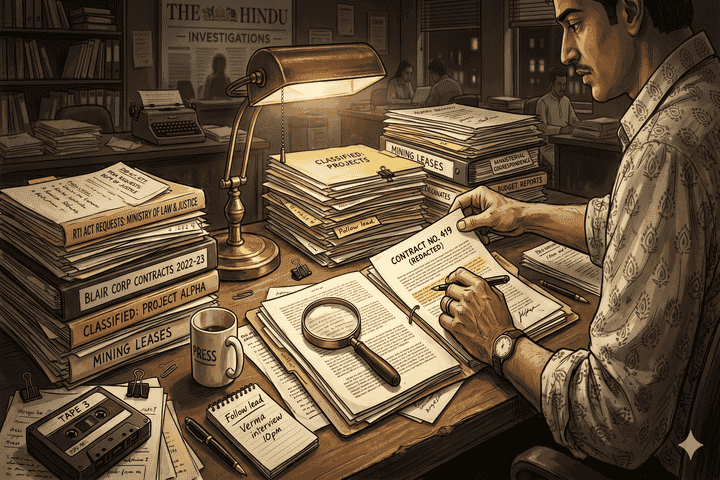
The defining aspect of The Hindu’s Bofors scandal investigation was its heavy dependence on documents. Long before digital archives, N. Ram’s team collected hundreds of primary sources—including contracts, correspondence, financial records, and official communications—and published them as is, allowing readers to see the chain of evidence clearly.
This approach highlights a key idea in investigative journalism: the most reliable evidence starts with original documents. These are considered more trustworthy than second-hand testimony, which, in turn, is valued more than mere inference. By understanding this hierarchy, journalists can prioritize their sources effectively to uncover the truth.
By making sure every claim is backed up by a solid, verifiable document, the team strengthened its reporting against one of the biggest challenges — the possibility that the story may be labeled as anonymous hearsay or driven by political agendas. This careful approach helps build trust and credibility with the readers.
The practice of ‘playing devil’s advocate on key story angles’, as N. Ram describes it, is a formal verification step that newsrooms now call adversarial editing or red-teaming: before publishing a claim, the team deliberately tries to disprove it.
This discipline separates investigative journalism from advocacy journalism — a distinction that BARC India, the Press Council of India, and standard journalistic practices regard as foundational.
The lesson for contemporary reporters is structural:
Build the story from the document up, not from the tip down.
A tip is a direction; a document is evidence. In India, instruments like the Right to Information Act 2005 have since institutionalized access to documents, making the investigative journalism methodology used in the Bofors case not just historically admirable but also practically replicable for any journalist willing to file systematic RTI applications.
Source Management and Verification

The breakthrough in the Bofors investigation came in April 1988, when Chitra Subramaniam discovered a ‘privileged, authoritative source’ — one whom N. Ram personally met and verified, and who, critically, never let the team down across the remaining months of the investigation.
This single detail captures the most intricate ethical challenge in investigative journalism: the responsible use of confidential sources. Journalism ethics frameworks, including those outlined by the Press Council of India and taught across BA(JMC) programs, identify several non-negotiable principles for source management.
First, a source’s credibility must be independently assessed — not merely accepted because the source claims authority. N. Ram’s decision to personally verify the source before relying on their material illustrates this principle in practice.
Secondly, once confidentiality is established, the reporter’s duty to safeguard a source’s identity should be considered absolute. Revealing a source not only breaches ethics but also discourages future whistleblowers.
Third, information from a confidential source should still be verified with independent evidence whenever possible — sources narrow the search, while documents provide conclusive proof.
The competitive environment of the Bofors scandal era — The Indian Express, with journalist Arun Shourie, was actively pursuing the same story — also illustrates that multiple newsrooms working independently on the same investigation, each with different sources and document sets, functions as a form of systemic verification.
When competing outlets reach convergent conclusions from separate evidentiary paths, the combined weight of their findings is substantially stronger than that of any single investigation.
Editorial Ethics in Practice
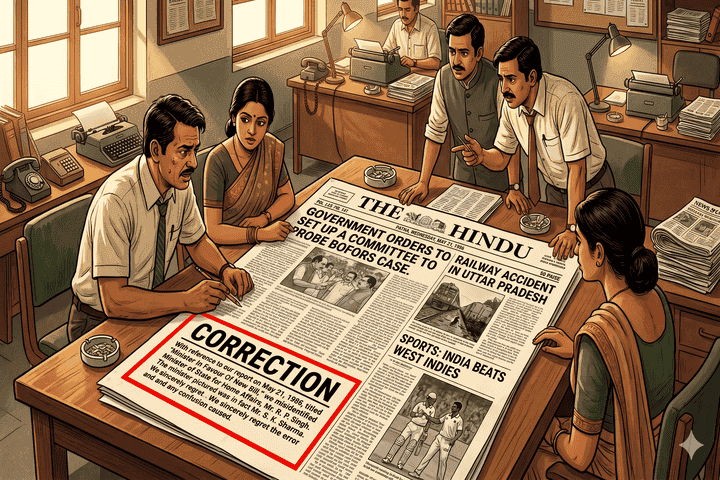
Among the most instructive episodes in the Bofors scandal investigation is one that most journalists would rather not publicize: The Hindu made a significant factual error, misconstruing something Prime Minister Rajiv Gandhi had said in a closed meeting. Instead of hiding the correction in a later edition, the paper prominently displayed it on the front page along with a clear apology.
N. Ram observes that some external observers considered this level of prominence ‘quite unnecessary,’ highlighting the difference between simply following correction norms and truly prioritizing reader trust.
The Press Council of India’s guidelines on accuracy and corrections also state that corrections should be as prominent as the original mistake. It also reflects the broader ethical principle that an institution’s credibility is gradually built through transparency and can be quickly damaged by concealment.
The team’s choice not to implicate individuals lacking sufficient evidence is equally important. Amitabh Bachchan’s case is explicitly mentioned as an example of restraint. Amid intense competitive and political pressures during the investigation, deciding to withhold a name when evidence is inadequate exemplifies what journalism scholars refer to as proportionality: the gravity of the allegation should align with the strength of the evidence.
The Bofors scandal investigation highlighted a persistent structural issue in Indian media law: the difference between journalistic standards of evidence — which are enough to publish — and the legal standards required to secure a conviction under the Indian Evidence Act. This discrepancy means that even detailed, accurate reporting cannot replace formal prosecution. This underscores why accountability journalism and judicial processes, although related, serve different roles.
Bofors Scandal as a Turning Point in India’s Journalistic Legacy
N. Ram frames the Bofors scandal in terms of five analytical modes:
- The decision-making on the howitzer selection
- The arrangements for payoffs
- The cover-up and crisis management
- The journalistic investigation and exposé, and
- The CBI’s criminal investigation with Swiss judicial cooperation
This five-part framework is pedagogically valuable because it clearly separates journalism’s role—investigation and public disclosure—from the state’s role in legal prosecution.
The journalistic process concluded with publication, while the legal phase persisted through the efforts of the CBI, the Swiss Federal Police, and a dedicated Special Court for CBI cases.

The outcomes of the legal phase were mixed: the key accused died before trial, Ottavio Quattrocchi evaded justice, and the gap between press findings and courtroom convictions became a defining feature of the case.
Yet the investigation’s political impact was transformative. The Bofors scandal became synonymous with high-level political corruption in India, entering the vocabulary of multiple Indian languages as a byword for institutional misconduct.
The Congress party’s defeat in the 1989 general elections is widely attributed, in significant part, to the sustained public pressure generated by The Hindu’s reporting.
For students of media and politics, this example highlights the press’s role in agenda-setting — showing how media can bring an issue from bureaucratic obscurity to the forefront of electoral politics.
The Bofors case also laid the groundwork for the growth of investigative efforts in the years that followed. It helped inspire important initiatives like the RTI Act (2005), the Whistleblowers Protection Act (2014), and the increasing use of data journalism and document-based reporting in Indian newsrooms, including outlets like The Wire, The Print, and many more.
In this sense, the investigation isn’t just a significant historical milestone; it also serves as a foundational template, with its methodological DNA shaping contemporary Indian accountability journalism.
Conclusion
The Bofors scandal investigation remains a significant reference in Indian journalism not due to securing convictions — which it did not entirely do — but because it showcased what systematic, document-based, ethically rigorous reporting can accomplish in a democracy where institutional accountability is challenged.
N. Ram’s retrospective account describes a newsroom guided by principles now officially embedded in press ethics, journalism training, and RTI law: verify information before publishing, correct errors visibly when identified, safeguard sources unconditionally, and maintain strict evidentiary standards despite competitive or political pressures.
For students studying journalism, mass communication, or media management, the Bofors case isn’t just history — it remains a relevant lesson. It highlights issues such as the disconnect between journalistic evidence and legal proof, the ethics of confidential sources, the influence of ongoing investigative series on agenda-setting, and the institutional bravery needed to hold powerful entities accountable — challenges that every Indian newsroom faces today.
The tools have evolved — RTI filings, data journalism, digital document verification — but the core methodology N. Ram talked about still stands out as the gold standard.