Media Mentorship in India
India’s media and entertainment sector is growing faster than almost anyone anticipated. According to the FICCI-EY Media and Entertainment Industry Report 2026, the sector reached INR 2.78 trillion (US$32 billion) in 2025—a 9% increase that outpaced India’s nominal GDP per capita growth of 7.7%—and is projected to cross INR 3 trillion by 2027, growing at a CAGR of over 7% through 2028.
The sector already provides direct employment to around 2.75 million people and indirect employment to over 10 million. India is producing nearly 200,000 hours of content annually, over 1,900 films were released in 2025, and digital advertising crossed INR 947 billion, constituting 63% of total ad revenues.
By almost every measure, the industry is thriving. And yet, entry into this booming sector remains unequal, opaque, and disproportionately dependent on geography and personal networks.
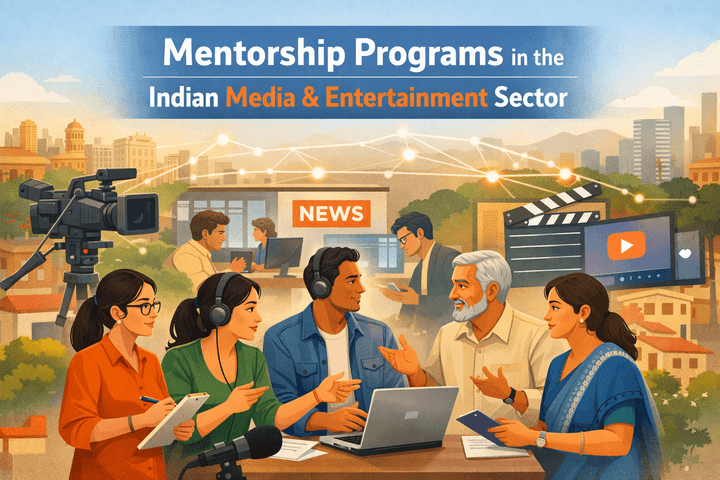
Structured mentorship — sustained, one-on-one guidance from working professionals to emerging talent — is the most practical intervention available to change this. The good news is that the policy environment, the workforce data, and the industry’s own growth momentum are, for the first time, all aligned to make it happen at scale.
A Growing Sector with a Shifting Talent Pipeline
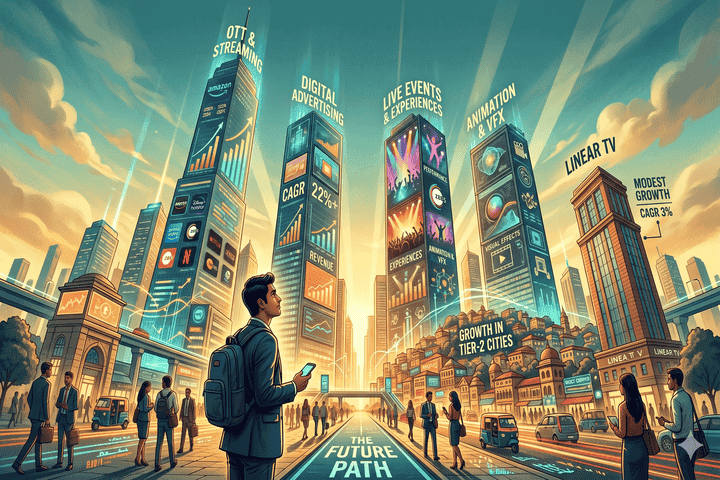
The growth story of India’s M&E sector in 2025 was not uniform, and that unevenness is precisely what makes it interesting to career seekers. Traditional broadcasting contracts declined, with linear TV losing 11.5 million Pay TV households as audiences moved to Connected TV and free platforms.
Meanwhile, digital advertising grew by 26%, OTT paid subscriptions exceeded 216 million, and live events increased by 44%, expanding far beyond the eight largest metro areas (FICCI-EY 2026).
Online gaming continues to be a key growth sector, projected to reach INR 92 billion in the video games segment by 2028 despite a four-month regulatory disruption.
Meanwhile, animation and VFX are expected to recover from global challenges as Hollywood pipelines stabilize and Indian producers increasingly incorporate VFX into mid-budget films.
The FICCI-EY 2026 report clearly indicates the direction of talent demand: the Government of India’s ‘Create in India’ initiative, unveiled at the India AI Impact Summit in February 2026, aims to establish the creative economy as a key focus area.
The Union Budget 2026–27 has allocated support for the Indian Institute of Creative Technologies (IICT), Mumbai, to establish AVGC Content Creator Labs in 15,000 secondary schools and 500 colleges.
Maharashtra has approved the AVGC-XR Policy 2025 with a budget of INR 32.68 billion, adopting a hub-and-spoke model with regional clusters in Tier-II and Tier-III cities—recognizing that talent development is no longer confined to Mumbai.
The FICCI-EY report also openly admits that there will be a continued shortage of top-tier creative and technical leadership in the near future.
While the government’s skilling pipeline will expand the entry-level talent pool, senior creative supervisors, narrative leads, and pipeline technical directors cannot be developed solely through school labs.
This gap—between a growing number of newcomers and a limited leadership tier—highlights the strategic importance of mentorship.
The Employability Picture: Improving, But Not Enough
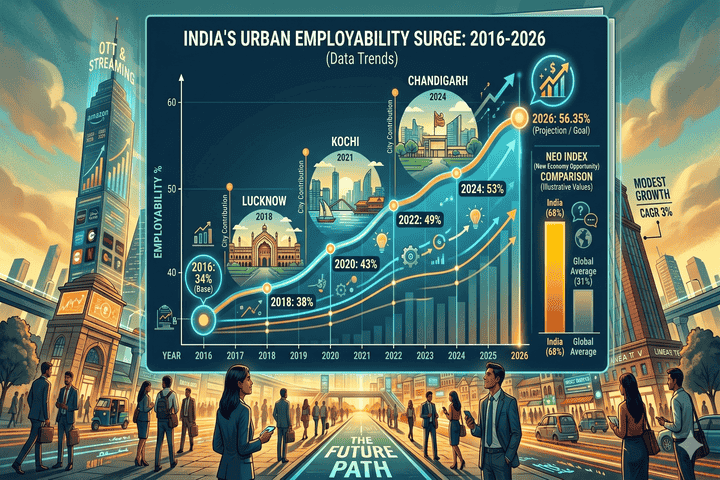
India’s overall employability rate has risen from 54.81% in 2025 to 56.35% in 2026, according to the India Skills Report 2026 (Wheebox-ETS), based on the Global Employability Test conducted across over 1 lakh candidates.
That steady increase from below 34% a decade ago is a real accomplishment, showing ongoing investment in STEM education, digital literacy, and industry-focused curricula.
Cities like Lucknow, Kochi, and Chandigarh at Tier-2 and Tier-3 levels are increasingly becoming vital employment hubs. This shift is helping to bridge the skill gap between urban and rural areas, which previously centered all career opportunities in the metropolitan regions.
The ISR 2026 highlights a positive hiring outlook: Indian organizations expect 40% of their planned hires in FY 2026–27 to be new positions, a notable increase from 29% last year, indicating ongoing growth and strong business confidence.
The ManpowerGroup Employment Outlook Survey Q2 2026 puts India’s Net Employment Outlook at 68%, the highest among the 42 nations surveyed. Seventy-four percent of Indian employers plan to increase their staff between April and June 2026, with large enterprises increasing hiring volumes by 104% over the previous quarter (ManpowerGroup MEOS Q2 2026). India’s hiring momentum is real, broad-based, and accelerating.
The main challenge isn’t a lack of jobs but rather the ongoing difficulty for media aspirants, especially those from non-metro backgrounds, in accessing and turning those opportunities into success.
The ISR 2026 notes that India now has an estimated 60 million professionals engaged in gig and freelance work, projected to reach 90 million by 2030, with the platform and gig workforce expected to reach 23.5 million by 2029–30.
For media graduates, exploring these new flexible work channels—such as OTT content contracts, branded content production, data journalism, and influencer management—can be an exciting way to start your career in the industry. However, it can feel overwhelming to navigate them without some guidance.
Who Still Gets Left Behind—and Why the Gap Is Manageable
India’s media career ecosystem still has well-documented structural exclusions that persist. Students from Tier-2 and Tier-3 cities, first-generation learners, and women in media continue to encounter significant disadvantages.
Women occupy only a small share of senior leadership roles in traditional broadcast and journalism. However, the OTT and streaming sectors demonstrate greater gender balance in leadership, indicating that newer digital-first organizations are structurally more open when access barriers are removed.
But the conditions for closing these gaps have meaningfully improved. The ISR 2026 highlights that the IT and manufacturing sectors are already investing in gender-balanced apprenticeships and AI mentorship platforms.
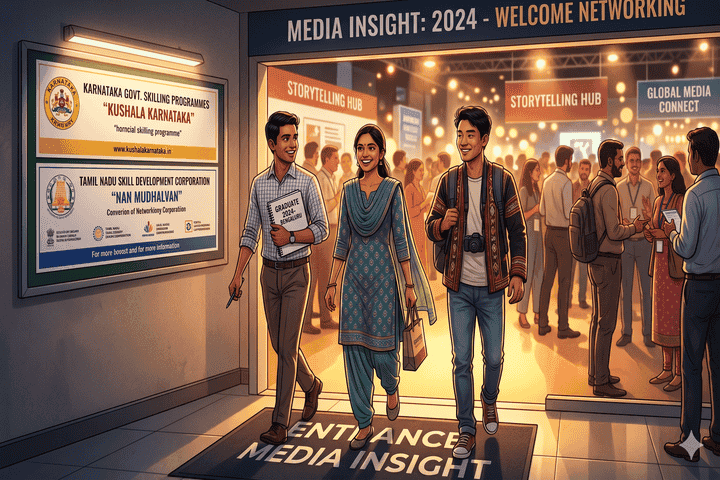
Karnataka’s Skill Development, Entrepreneurship, and Livelihood (SDEL) department has revitalized employment exchanges and District Skill Committees to facilitate apprenticeships and dual-training models in collaboration with industry, supported by the Karnataka Skill Connect Portal.
Tamil Nadu’s Naan Mudhalvan scheme—”Smooth Transition Post Schooling”—focuses on career guidance and mentoring for school leavers, with more than 1.12 lakh students benefiting from its Kalloori Kanavu college pathway program in 2024.
Bihar, Jammu & Kashmir, and Kerala all feature as state skilling partners in the ISR 2026 framework, each running distinct mentorship-adjacent programs that connect learners to employers.
At the national level, the media sector can leverage the apprenticeship and work-exposure infrastructure offered by the Pradhan Mantri Internship Scheme (PMIS) and the National Employability Enhancement Mission (NEEM 2.0).
What they lack is sector-specific expertise—the industry knowledge, editorial judgment, and professional standards that truly prepare a journalism student for a newsroom or make a VFX aspirant competitive in a studio. This final step is where mentorship provides value beyond what any government program can offer.
What Mentorship Achieves
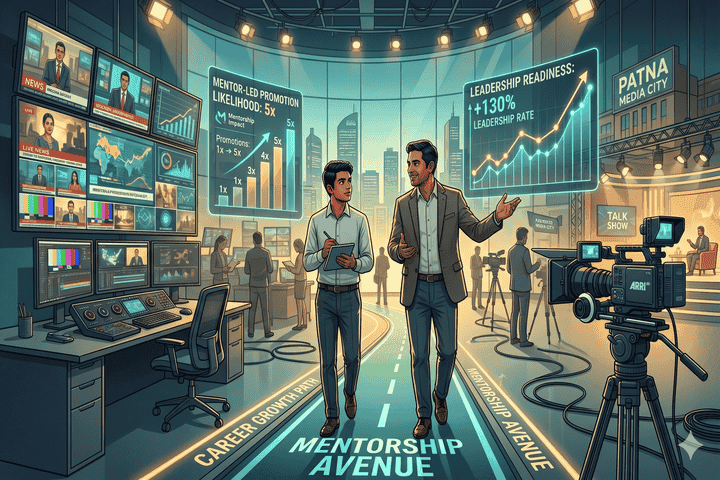
According to the American Society for Training and Development, the worldwide data on mentorship results is consistently positive. Employees with mentors are 5 times more likely to receive a promotion than those without one.
Harvard Business Review published an article stating that professionals who receive mentorship are 130% more likely to hold leadership positions. A Deloitte study found that 83% of professionals who had a mentor reported satisfaction with their career progression. LinkedIn research shows that 76% of professionals consider mentorship important to their success.
Regarding India’s M&E sector, the challenges are both structural and individual. The FICCI-EY 2026 report highlights that labor costs and talent availability are major constraints, with 53% of M&E CEOs considering talent availability a critical issue.
The industry isn’t lacking degree-holders; it lacks individuals with industry exposure, practical tool proficiency, and professional confidence to take on demanding roles. Mentorship directly addresses this need. A senior OTT producer who meets with a Tier-2 city graduate monthly for six months imparts more valuable career skills than any certification course.
The ManpowerGroup Q2 2026 survey adds a dimension that is directly relevant here: across industries globally, 40% of employers identify learning and development as the area where AI delivers the highest return on investment. However, the same survey indicates that 25% of employers believe AI cannot teach practical skills or judgment, and 22% feel it falls short in evaluating soft skills—exactly those competencies that mentorship helps build.
The implication is not that AI and mentorship compete with each other; rather, they complement one another. AI can provide content knowledge on a large scale, while mentors offer judgment, context, and professional identity.
What India’s M&E Sector Needs Now
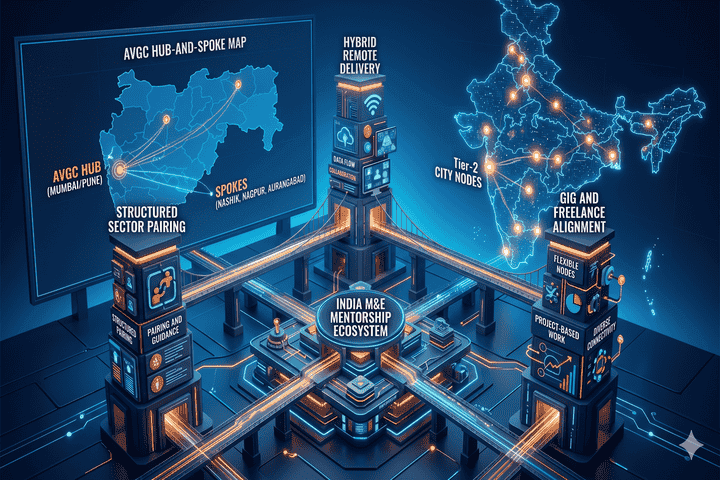
The policy framework, industry growth environment, and workforce data all suggest the same model for a scalable mentorship ecosystem. Several elements are already underway; what remains is to bring them together.
The initial requirement is to establish structured pairings with sector-specific focus. This involves long-term matches of at least six months between working professionals in OTT, gaming, VFX, advertising, journalism, and data analytics and students or early-career aspirants, including targeted outreach to non-metro participants.
Maharashtra’s AVGC-XR hub-and-spoke model offers a geographic framework, while the IICT school labs serve as the entry-level pathway. The key missing element is a structured mentorship system that links these participants with industry professionals.
The second approach is hybrid delivery. The ISR 2026 states that Tier-2 and Tier-3 cities are truly emerging as centers of employment, with Lucknow, Kochi, and Chandigarh specifically mentioned.
Remote-first mentoring, coordinated via NSDC’s digital platform or the National Career Service (NCS) portal, can connect mentors and mentees in these cities without the need for relocation.
The industry’s move toward distributed content production—FICCI-EY 2026 highlights that studios are establishing delivery pods in Tier II and III cities—builds a natural infrastructure backbone.
The third point is aligning with the shift towards gig and freelance work. Since India’s creative workforce is increasingly organized around platform-based tasks and project contracts, mentorship programs need to focus on this reality: guiding individuals on building a portfolio, managing gig contracts, pricing creative work, and transitioning between different projects.
The ISR 2026 highlights experiential learning via digital internships and platform-based work as quickly emerging as the most trustworthy method for developing employability in creative industries. Mentors capable of guiding aspirants through this landscape—focusing less on traditional employment pathways—are the ones who will have the greatest impact.
The Union Budget 2026–27, the Create in India mission, the AVGC-XR policies at both national and state levels, and the IICT school lab program have together created the broadest policy support for creative talent development that India’s M&E sector has ever seen.
The sector is expanding, with unprecedented hiring confidence and the talent pool becoming more geographically diverse. The case for structured mentorship isn’t driven by a crisis but by transforming a historic opportunity into sustainable, equitable careers. This represents a more positive narrative—one India’s media industry should be sharing today.
References
- FICCI-EY Media and Entertainment Industry Report 2026 (“Stories, Scale and Impact”), EY India, March 2026. Primary source for M&E sector valuation (INR 2.78 trillion), employment data (2.75 million direct jobs, 10 million indirect), sub-sector performance, AVGC policy initiatives, the Create in India mission, the IICT school lab program, and talent constraint analysis.
- India Skills Report 2026 (“The Future of Work”), Wheebox-ETS / CII / AICTE / AIU, 2026. Source for overall employability rate (56.35%, up from 54.81% in 2025), gig workforce projections (60 million active, 90 million by 2030, 23.5 million platform workers by 2029–30), hiring intent data (40% of planned hires as new roles in FY 2026–27), state skilling initiatives (Karnataka SDEL, Tamil Nadu Naan Mudhalvan, Bihar, Kerala, J&K), and NEEM 2.0 apprenticeship framework.
- ManpowerGroup Employment Outlook Survey Q2 2026, ManpowerGroup India, 2026. Source for India’s Net Employment Outlook (68%, highest globally across 42 countries), employer hiring intent (74% planning staff increases for Q2 2026), large-enterprise hiring volume growth (104% quarter-on-quarter), AI, and Learning & Development ROI data (40% of employers cite L&D as the highest AI ROI area) and AI limitations in practical skills and judgment assessment (25% and 22%, respectively).