
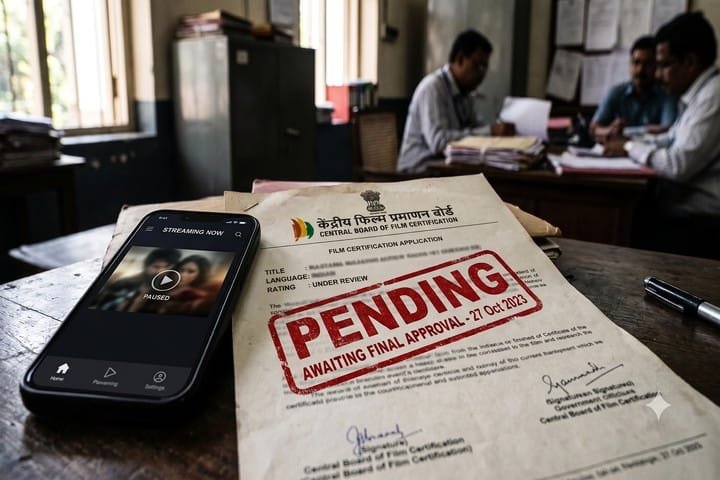
On July 3, 2026, Diljit Dosanjh’s film Satluj streamed on ZEE5 without a CBFC certificate. Within two days, the government ordered it taken down, citing national security concerns under the IT Rules, 2021.
The film, earlier titled Punjab 95, had waited four years for certification. The CBFC had asked for 127 cuts. The makers refused, and released it directly on a streaming platform instead. That decision triggered one of 2026’s sharpest disputes over who controls what Indian audiences can watch, and which regulatory door a film must pass through to reach them.
Satluj is based on the life of Jaswant Singh Khalra, a human rights activist who investigated the alleged mass cremation of unidentified bodies in Punjab during the insurgency years of the 1980s and 1990s. Khalra was abducted and killed by police personnel in 1995. His story sits at the center of one of India’s most documented human rights cases from that period.
It is also now at the center of a live test of India’s two-track content regulation system. A film releasing in theatres answers to the Central Board of Film Certification, a statutory body under the Cinematograph Act, 1952, which assigns a certificate before a single ticket is sold.
A film or series releasing directly on a streaming platform answers to the Information Technology (Intermediary Guidelines and Digital Media Ethics Code) Rules, 2021, enforced through a three-tier grievance mechanism.
Satluj tried to move from one track to the other. The government’s response, and the policy shift now under consideration because of it, shows how fragile the line between these two systems has become.
For students of media law, Satluj offers a clearer case study than any textbook example. It shows exactly what happens when a denied certificate meets an uncensored upload.
Why Cinema and OTT Are Governed Differently

The CBFC traces its authority to the Cinematograph Act, 1952, a law built for an era when film exhibition meant a physical print running through a projector in a licensed theatre. The Act gives the CBFC pre-censorship power. No film can legally be released in Indian theatres without a certificate, and the Board can order cuts before granting one, or refuse a certificate outright.
The Cinematograph (Amendment) Act, 2023 modernized this framework without changing its core structure. It made certification perpetually valid, removing the earlier requirement to renew after ten years. It also removed the central government’s power to re-examine an already certified film, giving the CBFC more functional independence.
Alongside these changes, the amendment introduced strict anti-piracy provisions. Unauthorized recording or exhibition of a film is now punishable by up to three years in prison and fines of up to 5% of a film’s audited production cost.
The IT Rules, 2021, by contrast, were notified under the Information Technology Act, 2000, a law originally built for e-commerce and cybersecurity. OTT platforms face no pre-censorship requirement. They self-classify content and respond to complaints only after release, through the grievance mechanism the Rules describe.
This difference is not accidental. Theatrical release happens through a controlled, single point of distribution, so pre-screening every film was administratively realistic. Streaming content reaches millions of devices simultaneously, so pre-screening every title at that scale was never considered feasible.
The result is a split system, and Satluj shows exactly how a filmmaker can attempt to exploit that split. Denied a CBFC certificate after refusing 127 suggested cuts, the makers released the film directly on ZEE5 under a new title, skipping the theatrical track entirely.
Streaming platforms carry no legal obligation to check whether a film has cleared CBFC certification before hosting it. The government’s swift takedown order shows the split is not a loophole without consequences. It is a gap the state can still close through other legal levers, in this case the emergency blocking powers under Section 69A of the IT Act.
The IT Rules 2021

The IT Rules, 2021 created India’s first formal content code for OTT platforms and digital news media. Platforms must self-classify content into five age bands: U, U/A 7+, U/A 13+, U/A 16+, and A, and attach content descriptors flagging violence, substance use, or sexual content.
Ten categories of material are barred outright, including content that threatens India’s sovereignty or is patently false on a matter of public importance. Enforcement runs through three tiers.
A Grievance Redressal Officer at the platform handles complaints first, within 15 days. A Self-Regulatory Body, headed by a retired judge, hears appeals and issues binding decisions. The Ministry’s Inter-Departmental Committee sits above both. The government also retains an emergency blocking power under Section 69A of the IT Act, which bypasses this entire chain in urgent cases.
Satluj was removed under exactly this emergency route, not through the ordinary three-tier grievance process. The Rules’ legal status has moved since 2021, but no single ruling has settled it.
The Bombay High Court struck down a specific provision, Rule 3(1)(b)(v), which empowered a government Fact-Check Unit to flag “fake or misleading” content about the government itself, in the case Agij Promotions of Nineteenonea v. Union of India. The Center appealed, and the Supreme Court agreed to hear that appeal in 2026, with the Solicitor General seeking a stay on the High Court’s verdict.
Separately, the Supreme Court transferred all other pending challenges to the 2021 Rules, including petitions in the Madras High Court from Carnatic vocalist T.M. Krishna and the Digital News Publishers Association, to the Delhi High Court. That court will take up the constitutional challenge to Part III of the Rules, the Code of Ethics governing OTT platforms and digital news, as its first order of business.
As of August 2026, that hearing is still pending. No court has issued a final ruling on whether Part III itself is constitutional. The Ministry has also floated a draft second amendment to the Rules in March 2026, proposing an ethics code for individual social media users sharing news, and a formal definition of obscene digital content.
How U, U/A, and A Ratings Actually Work

The CBFC evaluates every film before theatrical release through a certification committee that watches the full film and judges its overall impact, not just isolated scenes.
A U certificate means unrestricted viewing for all ages. An A certificate restricts a film legally to viewers aged eighteen and above, based on factors like strong violence, explicit language, or mature sexual content. It carries no implication about quality, only about audience suitability.
The U/A category sits between the two. The Cinematograph (Amendment) Act, 2023 split it into three age-specific bands recommended by the Shyam Benegal Committee in 2017: U/A 7+, U/A 13+, and U/A 16+. These are recommendatory markers, meant to guide parents rather than legally restrict access the way an A certificate does.
A U/A 16+ film might include moderate violence or emotionally intense themes suited to older teenagers, while U/A 7+ covers milder content still recommended for parental supervision at younger ages.
Unlike the OTT system, CBFC certification is a precondition for release, not a response to a complaint. A film cannot legally screen in an Indian theatre without clearing this process first.
This is precisely the step Satluj never completed. The makers submitted the film, then titled Punjab 95, for certification in 2022. The CBFC reportedly asked for 127 cuts. The makers did not accept them, and the certificate stayed pending indefinitely.
The film’s scheduled premiere at the Toronto International Film Festival in 2023 was also canceled, reportedly after Indian authorities raised objections abroad. Four years later, with no certificate granted and no cuts accepted, the makers released the film directly on a streaming platform instead, under the new title Satluj, bypassing the CBFC process the theatrical route required.
The Satluj Movie Controversy

Satluj is directed by Honey Trehan and stars Diljit Dosanjh, Arjun Rampal, Kanwaljeet Singh, Suvinder Vicky, and Geetika Vidya Ohlyan.
It dramatizes the work of Jaswant Singh Khalra, who investigated the alleged mass cremation of unidentified bodies by Punjab Police during the insurgency years between 1984 and 1994.
Khalra was abducted and killed in 1995. His story remains one of the most documented human rights cases from that period in Punjab’s history.
The film was released on ZEE5 on July 3, 2026, without CBFC certification. Ministry of Information and Broadcasting officials reviewed the content within two days and found issues they described as related to national security.
The Ministry sent ZEE5 a formal directive under the IT Rules, citing powers under Section 69A of the IT Act, which allows content blocking on grounds including sovereignty, security of the state, and public order.
ZEE5 complied and removed the film, posting a statement expressing hope to restore it and asking viewers not to turn to piracy. The political reaction split sharply. Shiromani Akali Dal president Sukhbir Singh Badal said the film needed to reach younger generations so they would understand what happened to Khalra and other Sikh youth during that period.
Union Minister Ravneet Singh Bittu rejected suggestions that the Center or the BJP had political motives, arguing that CBFC rules apply to theatrical releases while OTT and satellite content fall under separate frameworks.
The Delhi Sikh Gurdwara Management Committee opposed the takedown directly and called for public screenings, and the film has since been screened at gurdwaras across several states outside the formal theatrical or streaming system altogether.
A public interest litigation followed on July 9, 2026, filed in the Punjab and Haryana High Court by Sharwan Singh, naming the Union Government, the CBFC, the Punjab Government, Zee Entertainment Enterprises, and ZEE5 as respondents.
The petition argued the removal violated the constitutional right to free expression under Article 19(1)(a) and the public’s right to receive information, since no statutory order or judicial direction had been made public.
A bench of Acting Chief Justice Ashwani Kumar Mishra and Justice Rohit Kapoor questioned whether the petitioner had standing to bring the case at all, since he was neither the film’s director nor its producer. Facing that challenge, the petitioner indicated he would withdraw the plea and refile it through the film’s director.
The case remains open in that revised form. Satluj is also not an isolated dispute. It is the second Punjab-related ZEE5 title to draw government scrutiny in 2026, following an earlier advisory against streaming the documentary series Lawrence of Punjab.
The Push for Mandatory OTT Certification
The Satluj episode has already produced a concrete policy response. Government sources say the Center is examining an amendment to the IT Rules, 2021 that would make CBFC certification mandatory before any film can be released on an OTT platform.
As things stand, OTT content falls entirely outside CBFC jurisdiction. The Ministry of State for Information and Broadcasting confirmed this in a written Lok Sabha reply as recently as December 2025, stating that OTT content is regulated only under Part III of the IT Rules. If the proposed amendment goes through, it would reverse that position entirely.
Every film intended for streaming release would need to clear the same certification process theatrical films already go through, closing the exact gap Satluj exploited. Officials are also reportedly weighing action against ZEE5 for streaming a film while its CBFC application remained pending, treating the platform’s choice as a compliance failure rather than a simple content dispute.
The proposal raises questions the government has not yet answered publicly. It is unclear whether mandatory certification would apply only to subscription-based platforms or extend to films distributed through video-sharing sites.
It is also unclear how the rule would treat documentaries, imported titles, or films that release directly online without any planned theatrical run. Each of these questions determines how far the CBFC’s reach would extend into a medium it has never regulated before.
For now, this remains a proposal rather than a notified rule. But its very existence marks a shift in thinking. India built two separate systems for cinema and streaming because the two mediums behaved differently. Satluj is the case that convinced policymakers those differences may no longer justify two separate rulebooks.
Censorship Matters

For anyone entering media production, distribution, or policy work in India, the Satluj case offers a live template for how content disputes now unfold.
A producer weighing theatrical release against a direct-to-streaming release is not simply choosing a distribution channel. They are choosing which regulator, and which level of pre-release scrutiny, their film will answer to, at least until any mandatory certification rule changes that calculation.
Three points are worth remembering for both exam preparation and industry practice.
- First, the CBFC’s power comes from the Cinematograph Act, 1952, as amended in 2023, while the IT Rules derive from the IT Act, 2000. Any comparison question should identify the correct parent statute for each system.
- Second, CBFC certification remains pre-emptive and compulsory for theatrical release, while IT Rules compliance remains reactive and complaint-driven for OTT content, though Satluj shows the government can still act quickly through Section 69A when it judges a case urgent enough.
- Third, the constitutional status of the IT Rules’ Part III code of ethics is still undecided, with the matter now consolidated before the Delhi High Court. Students citing this topic in 2026 should describe it as pending, not resolved.
Satluj also illustrates something no textbook definition fully captures: the human stakes behind a certification dispute. A film about a real activist’s documented death became a flashpoint precisely because certification, platform self-regulation, and government blocking powers all intersected on a single, politically sensitive story.
Understanding how these mechanisms interact, rather than studying each in isolation, is what actually prepares students to analyze the next case that follows the same pattern.
Conclusion
Placing the CBFC and the IT Rules side by side used to be a mostly theoretical exercise. Satluj made it concrete. A film denied a theatrical certificate reached audiences anyway, through a streaming platform with no pre-release check of its own, until the government invoked emergency powers built for exactly this kind of gap.
The dispute over Satluj is not settled. The Punjab and Haryana High Court case continues in revised form, the Delhi High Court has yet to rule on the constitutionality of the IT Rules’ Part III, and the Center’s proposed move toward mandatory OTT certification remains at the discussion stage.
What the case has already settled is smaller but real. It has shown, in public and in real time, exactly where India’s two content regulation systems meet and where they still fail to align.
For India’s media and entertainment sector, now built substantially around streaming growth, the outcome of these pending decisions will determine how much creative and political latitude platforms retain, and how closely the OTT world starts to resemble the theatrical one it was originally built to bypass.
References
- CBFC Guidelines
- The Information Technology (Intermediary Guidelines and Digital Media Ethics Code) Rules, 2021 (updated as of 6.4.2023)
- Punjab & Haryana High Court Refuses To Entertain PIL On Restoration Of Diljit Dosanjh Starrer ‘Satluj
- After Satluj row, Center eyes mandatory CBFC certification for OTT films
- Cinematograph (Amendment) Bill, 2023
Key Highlights
- Satluj, denied CBFC certification after the makers refused 127 suggested cuts, was released on ZEE5 on July 3, 2026, and was pulled within two days under the IT Rules’ Section 69A emergency powers, citing national security.
- No court has issued a final ruling on the constitutional validity of the IT Rules, 2021. The Supreme Court transferred all pending challenges to the Delhi High Court, which has yet to hear the core Part III case as of August 2026.
- The Satluj row has pushed the Center to consider making CBFC certification mandatory for OTT releases, a proposal that would fundamentally merge India’s currently separate cinema and streaming regulatory tracks.