
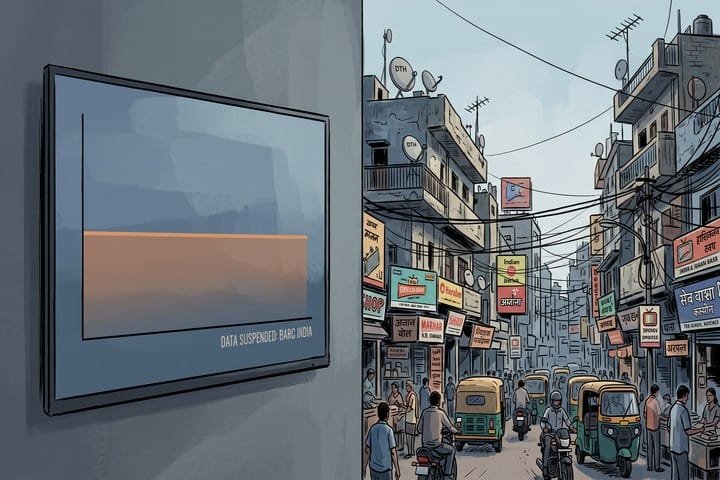
What a TRP Rating Is and How It Is Calculated
A TRP rating is a number that determines how billions of rupees in advertising are allocated each week. TRP stands for Television Rating Point, and it measures the share of a defined audience that watched a particular channel or program in a given time slot.
A TRP of 1 means that roughly 1 percent of the measured audience watched the program. In India’s television industry, Television Rating Point and Television Rating (TVR) are used interchangeably, as both refer to the same percentage.
What varies is the audience group being measured, as ratings are reported separately by market, language, age group, and socio-economic category.
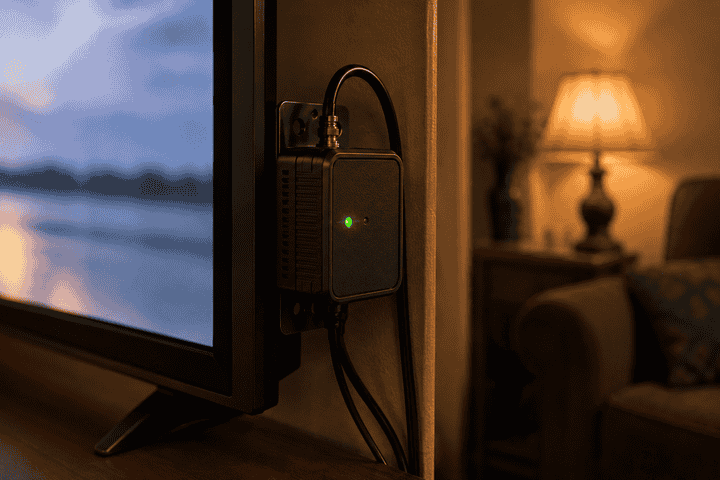
TRP data comes from a panel of selected households. The Broadcast Audience Research Council (BARC) installs people meters in these homes to record which channel each television is tuned to and which household members are watching.
Panel homes are not randomly selected from across the country. Panel homes are carefully selected to represent the national television audience across regions, languages, income levels, and household sizes.
The size of that universe is determined by a separate exercise called the Establishment Survey. It estimates how many households own televisions and what their profile is.
Under current policy, the survey must be conducted every three years using a sample at least ten times larger than the number of metered homes. Ratings are converted into advertising value through Cost Per Rating Point (CPRP), the amount an advertiser pays for each rating point a program delivers.
A media planner uses a show’s previous-season TVR and the negotiated CPRP to estimate the cost of a ten-second advertising slot. Multiplying the program’s rating by the total audience universe gives the program’s impressions, the estimated number of viewers an advertiser reached.
This is why audience measurement matters. BARC’s weekly Thursday release is more than a viewership scoreboard. It is the currency on which the entire television advertising market is priced.
From TAM to BARC and the Making of a Ratings Monopoly
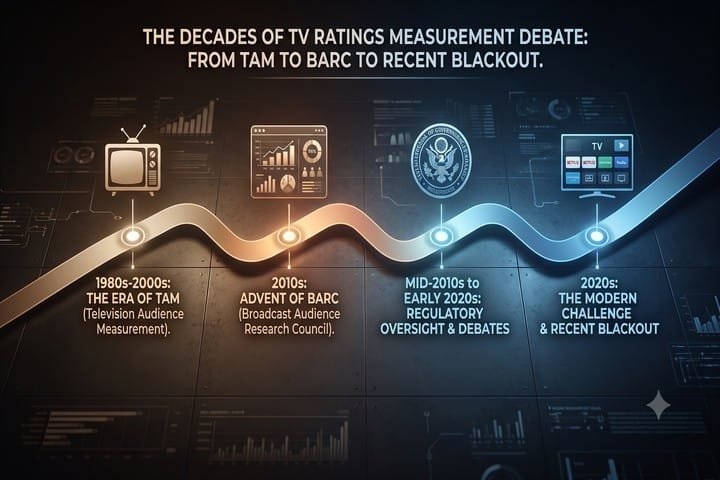
India used TAM Media Research to measure television viewing until 2015. TAM faced ongoing complaints regarding panel size, transparency, and ownership structure.
To address these issues, BARC India was established to provide independent, statistically reliable viewership data. It is now the only registered television audience measurement agency in the country.
Ownership has remained a point of debate, as the Indian Broadcasting and Digital Foundation, which includes JioStar, Zee Entertainment Enterprises, Sony Pictures Networks India, and Sun TV Network, holds a 60 percent stake in BARC.
The broadcasters being measured, therefore, hold a majority stake in the organization that measures them. Confidence was shaken in October 2020 when Mumbai Police began investigating allegations of ratings manipulation following complaints from BARC and Hansa Research, one of its field vendors.
The investigation named Republic TV as one of the channels involved. BARC subsequently suspended news ratings for eighteen months, resuming publication in Week 10 of 2022.
A revised standard for news and special interest genres now reports audience estimates on a four-week rolling average rather than week by week. This reduced the short-term volatility that could be exploited, but broader structural concerns remained.
BARC’s panel comprised roughly 59,000 metered homes, which critics considered insufficient to represent hundreds of millions of viewers across dozens of languages.
The governing guidelines, introduced in January 2014, remained structurally unchanged for more than a decade. In November 2025, the Ministry of Information and Broadcasting issued draft amendments.
The draft proposed gradually expanding the panel to 1.2 lakh households. It also tightened cross-ownership restrictions between broadcasters and rating agencies, required technology-neutral measurement that included connected television, and established a minimum net worth of Rs 5 crore. These proposals set in motion the regulatory overhaul that ultimately halted the publication of ratings.
The Landing Page Problem and the TV Ratings Policy 2026
A landing page is the channel displayed automatically when a set-top box is switched on, without any choice by the viewer. For more than a decade, broadcasters paid cable and DTH operators for these default placements, and the resulting automatic tune-ins were counted as genuine viewership.
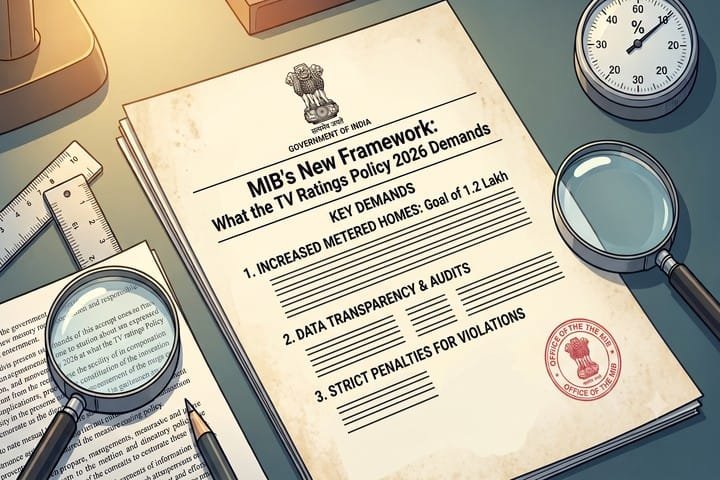
Channels were effectively buying ratings rather than earning them through deliberate viewer choice. The Television Ratings Policy 2026, notified on 27 March 2026, prohibited landing-page impressions from being counted, and BARC moved to exclude them from ratings calculations from 30 May 2026.
Republic Media Network editor-in-chief Arnab Goswami publicly welcomed the change, saying it would level the playing field for smaller channels. The policy also introduced several other requirements.
- Panel expansion to 80,000 metered homes.
- At least 33 percent of the directors on a rating agency’s board must be independent, with no association with broadcasters, advertisers, or advertising agencies.
- Cross-screen measurement covering both linear television and connected television.
- Establishment surveys every three years.
Following pressure from IBDF over implementation timelines, an amendment issued on 8 May 2026 relaxed four provisions. Among the changes, the required proportion of independent directors was reduced from 50 percent to 33 percent.
The registration period for existing agencies was extended from 30 to 60 days, giving BARC until May 26, 2026, to apply. The deadline for installing people meters was also postponed, while the landing page provision was challenged in court.
On 22 May 2026, the Kerala High Court granted an interim stay that halted its implementation. Justice Bechu Kurian Thomas lifted the stay on 24 July 2026, clearing the way for the revised methodology to take effect.
Despite the market opening, Nielsen confirmed that it had no plans to enter India’s television ratings sector. It remains active in the country through TAM Media Research, its joint venture with Kantar, which provides advertising and audience analytics but does not operate as a ratings agency. The policy change therefore failed to attract a new entrant.
What Happens When TRP Ratings Stop
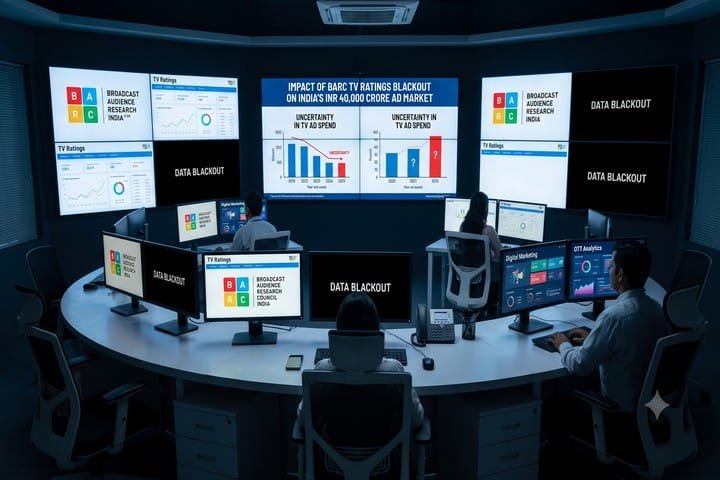
The suspension unfolded in two stages. In March 2026, the ministry directed BARC to withhold news channel ratings, citing sensationalist coverage of the West Asia conflict. The pause was intended to last four weeks but continued for nearly two months.
On 1 July 2026, the ministry extended the suspension to all genres pending BARC’s registration under the new policy. BARC had submitted its application on April 29, 2026.
The effects were felt across the market. Without fresh data, media planners reverted to historical benchmarks, favouring established broadcasters over channels whose performance had recently improved.
Parle Products chief marketing officer Mayank Shah warned that advertisers would seek steeply discounted, fixed-CPRP deals, putting rates for major reality programmes under pressure.
Dabur India media head Rajiv Dubey said cricket faced less risk because broadcasters and advertisers could rely on years of consistent reach data for the format.
The timing compounded an existing downturn. FICCI-EY reported that linear television advertising revenue fell by 10.3 percent in 2025, while advertising volumes declined by 11.5 percent and the number of advertisers dropped by 3 percent to 7,275. Hindi entertainment channels recorded an 18 percent fall in advertising revenue.
FMCG companies reduced television spending by 20 to 30 percent, shifting budgets towards connected television, streaming, and quick commerce.
Estimates of the market’s size vary because they use different bases for measurement. FICCI-EY valued linear television advertising at Rs 26,300 crore in net revenue for 2025, while gross-billing estimates placed the same market closer to Rs 40,000 crore. Both figures are often cited without explaining the distinction, leading to inconsistent published comparisons.
During the news ratings blackout, broadcasters turned to alternative indicators. Times TV Network chief executive Ashish Sehgal said news viewership had grown by 35 to 37 percent during the period, although no channel-level ratings were available to verify the claim.
ABP News Network president Mona Jain reported that advertising rates increased during the concurrent election cycle. Broadcasters also used YouTube viewing figures and data from DataBeans and Chrome Track to demonstrate performance.
TV9 Network said the continued absence of ratings was beginning to affect incremental advertising flows. For an examination of how the freeze affected festive-season deals for Bigg Boss and Kaun Banega Crorepati, see the post on the BARC ratings freeze.
Beyond TRP and the Fragmented Audience
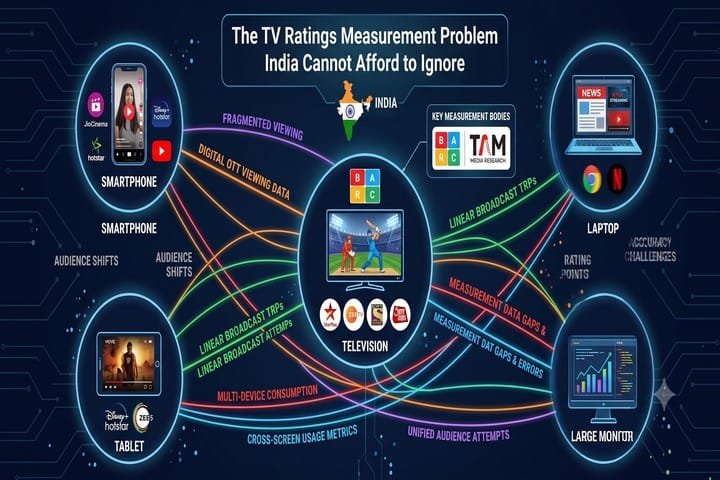
The deeper problem is that the panel was designed for a media landscape that no longer exists. India’s video audience is now fragmented across linear television, streaming services, social media, and connected television sets.
Kantar’s Media Compass report found that connected television reached 166 million monthly viewers in the first quarter of 2026, with more than a third of them unreachable through linear television.
Puneet Avasthi, director of specialist businesses at Kantar South Asia, continues to describe linear television as the bedrock of media planning. However, he argues that brands must now combine it with streaming, YouTube, and social media.
What the industry lacks is a single cross-media measurement currency. Without one, advertisers cannot accurately calculate unduplicated reach or control how frequently the same person sees an advertisement.
The result is wasted spending: one audience segment may see a campaign eleven times across four platforms, while another does not see it at all.
The Television Ratings Policy 2026 moves toward a technology-neutral system, with unified measurement across television and streaming as its stated goal. Regulation is evolving alongside it.
In June 2026, the ministry released the draft Telecommunications (Television, Radio, and Associated Services) Rules for consultation. The proposed rules would bring app-based linear distribution and free ad-supported streaming services under a formal regulatory framework.
TRAI was separately preparing a broader review of broadcast pricing and distribution. The New Tariff Order of 2019 had contributed to the pay-TV subscriber base declining to 84 million.
Creating a unified measurement currency will require coordinated action from the ministry, TRAI, BARC, broadcasters, and advertisers. No single organization currently possesses both the authority and the technical capacity to build it alone.
Conclusion
A TRP rating may look like a simple percentage, but it depends on a panel of metered homes, a survey that estimates the national television universe, and rules that define what counts as viewing. Change any one of these elements, and the TRP rating will change.
Excluding landing-page impressions is not merely a technical adjustment; it redistributes advertising revenue among channels. Likewise, expanding the panel from 59,000 to 80,000 homes can alter which programs appear to be succeeding.
Audience measurement is therefore not a neutral record of viewer behavior. It is a system of definitions with significant commercial consequences.
The 2026 suspension exposed those stakes. India went for months without its television advertising currency while the regulator, a broadcaster-owned measurement body, and the Kerala High Court debated what should count as genuine viewership. Meanwhile, the market continued trading using historical data, alternative metrics, and informed guesswork.
Whether ratings return under provisional registration or full approval, the fundamental challenge remains unresolved: a panel designed to measure one screen cannot adequately represent an audience fragmented across linear television, streaming, social media, and connected television.
References
- Ministry of Information and Broadcasting (27 March 2026). Television Rating Policy, 2026
- Indian Television (22 May 2026). BARC revamps TRP system, news channel ratings to resume from June 11
- exchange4media (2 July 2026). No ratings, no benchmark: TV industry braces for fallout of BARC TRP blackout
- BestMediaInfo (August 2026). I and B Ministry recommends BARC ratings resumption through provisional registration
- Indian Television (24 July 2026). BARC stays off the grid as no agency applies under new TV ratings policy
- Deccan Herald. BARC resumes ratings after TRP scam probe
- EY India. FICCI-EY Media and Entertainment Report 2026
Key Highlights
- A TRP rating measures the share of a defined audience that watched a channel or program. BARC calculates it using people meters installed in panel homes, while CPRP converts each rating point into advertising value.
- BARC replaced TAM Media Research in 2015 and remains India’s only registered television ratings agency. The Indian Broadcasting and Digital Foundation holds a 60 percent stake, giving the broadcasters being measured majority ownership of the organization measuring them.
- The Television Ratings Policy 2026, notified on 27 March and amended on 8 May, excludes landing-page impressions, requires 80,000 metered homes, mandates 33 percent independent directors, and introduces cross-screen measurement. The Kerala High Court stayed the landing-page provision on May 22 and lifted the stay on July 24, 2026.
- News ratings were suspended in March 2026, followed by ratings for all genres on 1 July, pending BARC’s registration under the new policy. In August, the ministry recommended provisional registration subject to compliance and a review in January 2027.
- Kantar reported that connected television reached 166 million monthly viewers in the first quarter of 2026, more than a third of whom could not be reached through linear television. India still lacks a unified cross-media measurement currency.