For India’s television industry, August through December is a peak period. This festive season, including Ganesh Chaturthi, Navratri, Diwali, and the year-end shopping rush, sees broadcasters launching their top shows and advertisers investing heavily to target engaged viewers.
However, this year’s carefully planned cycle has encountered an unforeseen obstacle. The Broadcast Audience Research Council (BARC), India’s television ratings body, has been directed by the Ministry of Information and Broadcasting to withhold its ratings data over non-compliance with the Television Rating Guidelines, 2026.
Understanding how this blackout affects media planning gives valuable insight into the operation of India’s television advertising industry and explains why data, rather than content, has become the currency that keeps it running.
What Triggered the Blackout and Why it Matters Now
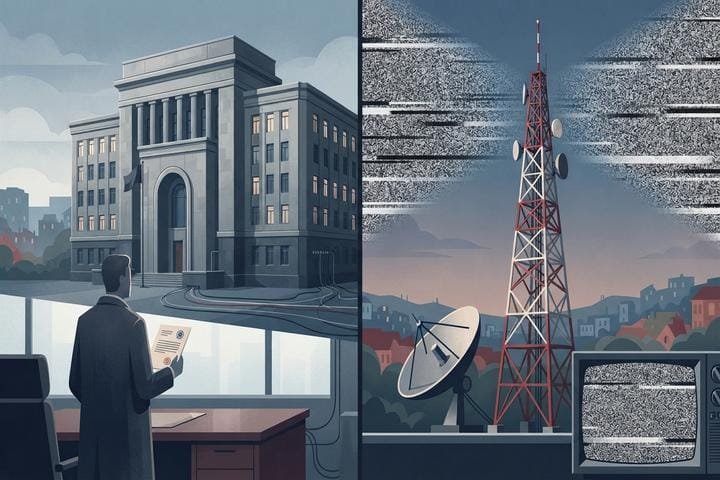
The disruption originates from a directive by the Ministry of Information and Broadcasting, which ordered BARC to halt the release of television ratings due to non-compliance with the Television Rating Guidelines, 2026.
BARC is the industry body that tracks viewership metrics, including which channels and programs are watched. Its data, known as TVR (television rating points), is essential for determining how advertising slots are bought and sold within Indian television.
The suspension has arrived during a particularly sensitive period. The August to December timeframe is considered television’s peak advertising season, aligning with major festivals and the release of prominent reality and entertainment shows like Kaun Banega Crorepati, Bigg Boss, and India Ke Top 1 Percent. These programs rely heavily on ratings-driven ad pricing.
Advertisers depend on BARC ratings to set their cost-per-rating-point (CPRP) deals. When fresh data isn’t available, it can make negotiations more challenging, potentially leading to delays in ad commitments and lower rates. This situation is especially tough just as the season’s biggest revenue opportunity begins.
It comes at a time when television advertising is already facing declining revenues, a shrinking pool of advertisers, and a larger shift of ad spending to digital and connected TV platforms.
Understanding CPRP and TVR: The Metrics That Drive TV Ad Deals

Let’s explore two important terms to see why a ratings blackout can be so disruptive.
TVR (Television Rating Point) indicates the percentage of the target audience that watched a specific program or channel during a set time slot. For instance, a TVR of 1 signifies that about 1 percent of the measured audience watched that program.
CPRP (Cost Per Rating Point): CPRP is the cost an advertiser pays for each rating point of viewership that a show delivers. Media planners use CPRP to negotiate airtime expenses based on a show’s projected or past ratings.
Under normal circumstances, broadcasters and advertisers use last season’s TVR data as a benchmark to price the upcoming season’s slots. However, reality shows are well-known for being unpredictable.
As Mayank Shah, CMO, Parle Products, explained: “Reality shows are likely to be among the biggest casualties of the current TV ratings blackout. Media planning for these properties is driven by CPRP, and without current ratings, there is no objective benchmark for planning or pricing. Reality show ratings are inherently volatile — a show that delivered a 1 TVR last year may not repeat that performance this year and could perform either worse or better.”
He added that the absence of data is likely to push both sides toward more conservative, discounted deals: “In the absence of fresh audience data, advertisers may have to negotiate flat CPRP deals at discounts of 30-40 per cent. Currently, the average corporate rate for reality shows is around INR 1.75 lakh to INR 2 lakh, and that is likely to come under pressure.”
Reality Shows vs Cricket
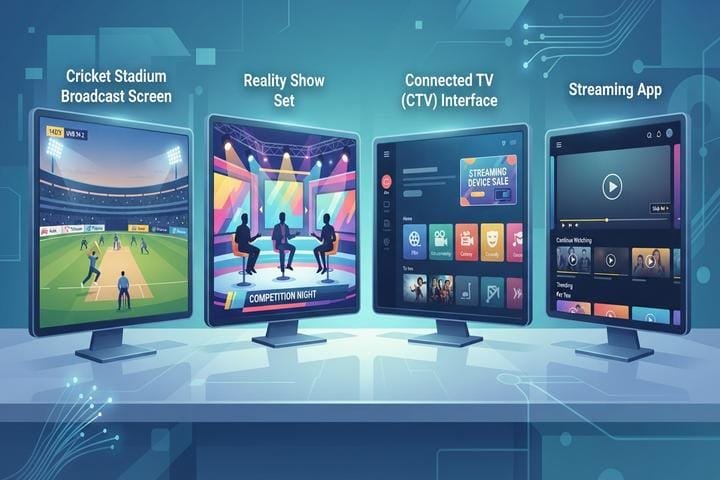
Not all television genres will be affected equally by the blackout. Rajiv Dubey, VP and head of media at Dabur India, explains that the impact will be most significant for annual, ratings-driven programs: “If the ratings blackout persists for a long time, it could seriously affect TV media planning.
Reality shows may experience some effects since their advertising deals are usually negotiated yearly. However, viewership for reality shows has remained mostly steady for a while.
In contrast, cricket is less likely to be significantly affected because advertisers and broadcasters already have a clear grasp of the audience size each format generally attracts.
This distinction matters because cricket broadcasts, unlike reality television, have built up years of consistent, predictable viewership patterns that both broadcasters and advertisers already trust, reducing their dependence on real-time rating updates for pricing decisions.
Media buying is becoming increasingly fragmented, with advertisers choosing across linear TV, connected TV (CTV), and OTT platforms. Even within linear TV, audiences increasingly choose between standard-definition (SD) and high-definition (HD) channels. In such a fragmented market, data becomes even more critical.
The BARC ratings blackout will significantly affect advertisers who depend heavily on linear TV. Meanwhile, OTT remains somewhat opaque due to limited transparency in data sharing. In this context, building strong relationships with advertisers will become even more important.”
This fragmentation — audiences splitting across linear TV, CTV, OTT, and even SD versus HD channels — means that reliable measurement is no longer a nice-to-have; it’s the foundation on which the entire ad-buying process rests.
Market Under Sustained Pressure
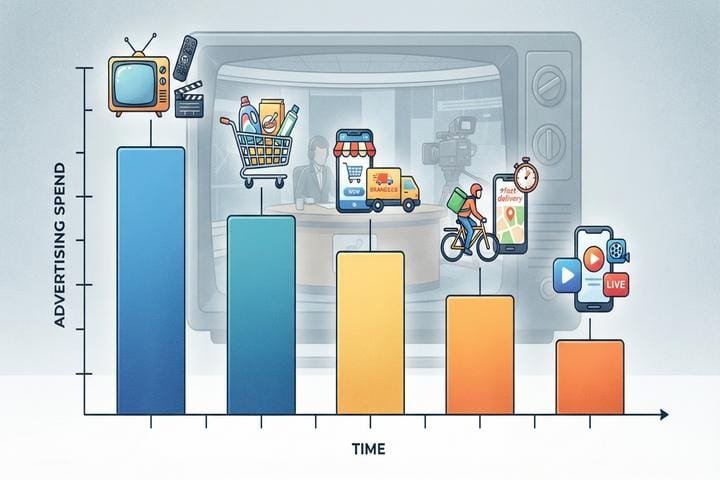
The BARC ratings blackout worsened issues that had already been affecting Indian television advertising prior to this disruption. As per a FICCI-EY report, linear TV advertising revenue declined by 10.3 percent in 2025, mainly due to an 11.5 percent decline in ad volumes.
The number of advertisers on television also shrank, falling 3 percent year-on-year to 7,275. The decline was especially steep for Hindi-language entertainment channels, which saw advertising revenue drop by 18 percent. Overall, TV ad spends in India are pegged at up to INR 40,000 crore.
TV advertising had already been hit by the conflict in West Asia and by a pullback in FMCG spending, which has historically been the backbone of TV advertising. FMCG ad spend on TV has declined by 20-30 percent. They are shifting budgets to platforms such as CTV, OTT, and quick commerce.
The ratings blackout couldn’t have come at a worse time, as the industry was hoping to see green shoots during the festive season.
Conclusion
The BARC ratings blackout highlights how Indian television advertising relies heavily on a single, centralized measurement system. When this system is disrupted, even briefly, the entire pricing framework for shows, whether reality TV or daily soaps, loses its stability.
For media and advertising students, this episode highlights a key lesson: audience measurement isn’t just a behind-the-scenes statistic but the core of the entire television advertising industry. Any disruption to it rapidly impacts brand budgets, broadcaster revenues, and programming strategies.