
This article contains affiliate links. As an Amazon Associate, Indian Media Studies earns from qualifying purchases at no extra cost to you.
Models of communication is a fundamental unit of each and every mass communication syllabus in India. They are often presented as diagrams, and students tend to memorize them as is, without understanding the underlying logic.
This fundamental mistake not only costs marks but also leaves a significant gap in understanding the nuances of communication at a later stage.
A model is an argument about how meaning moves between people, and each one was built to solve a problem the previous model could not.
Aristotle described persuasion in a physical assembly where the speaker could see every listener. Shannon and Weaver were engineers solving signal loss on a telephone line. Schramm was trying to explain why two people who hear the same broadcast walk away with different beliefs.
Reading these models in order reveals how the communication field itself has evolved in its understanding of audiences. They moved from treating people as targets to treating them as participants.
This guide covers the models listed in the UGC NET Paper II syllabus, the CUET UG Mass Media paper, and the BA (JMC) first-semester course.
Each section explains what the model claims, where it breaks down, and how it applies to Indian media. Where a model has an Indian parallel, such as the Sadharanikaran theory drawn from Bharata Muni’s Natyashastra, a connection has been drawn out.
After reading this article, students should be able to place any model on a timeline and say what it was reacting against.
What a Communication Model Is, and Why the Sequence Matters
A model is a simplified representation of a process. It simplifies the details so one can easily see how the underlying mechanism works.
In communication studies, a model outlines the parts of the process of communication and shows how they connect. These parts are found in nearly every model.
There is a source, a message, a channel, a receiver, and some notion of effect. What changes is the relationship between them.
Readers new to this vocabulary should start with the principle of communication and the concept of mass communication, then return here.
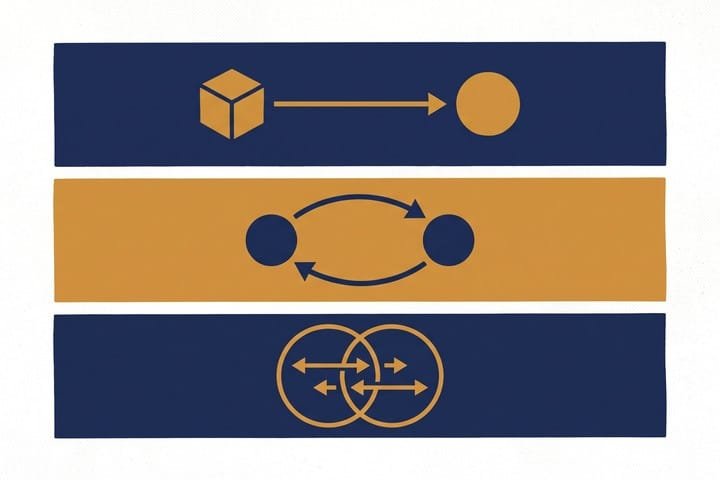
Models are usually grouped into three families.
- Linear models treat communication as a one-way transfer from sender to receiver. Aristotle’s model and the Shannon and Weaver model belong to the linear model family.
- Interactive models incorporate feedback, allowing the receiver to respond and the sender to improvise in response. Wilbur Schramm’s model belongs to this family.
- Transactional models see both parties as active participants, constantly exchanging messages and influencing each other in real time.
The sequence is important in understanding the core tenet of communication models. Linear models emerged when radio and film were new, and audiences were mostly passive observers. Interactive models followed empirical research, which indicates that people resist, reinterpret, and ignore messages. Transactional models arrived once scholars accepted that context, culture, and relationship cannot be separated from the message.
For instance, comparing Lasswell’s linear model (1948) with Schramm’s (1954) interactive circular model is also a way to assess the understanding of the inclusion of feedback and the field of experience.
Models have practical implications across communication work. A public campaign designer uses models as checklists to determine why a rural sanitation campaign is not producing the desired result, and the underlying model indicates where the fault lies.
A linear model points to the message and the channel. An interactive model like Schramm’s points to the gap between the campaign’s assumed audience and the actual one.
Westley and MacLean’s model points to the intermediary who decided what reached the village at all. Different models produce different diagnoses, and the diagnosis determines the solution.
The Linear Models: Aristotle, Lasswell, Shannon and Weaver, Berlo
Aristotle introduced the earliest model in the Rhetoric, dating back to around the fourth century BCE. He identified the speaker, the speech, and the audience, and he argued that persuasion depends on ethos, pathos, and logos.
The setting was the public assembly, so the model assumes a speaker addressing a crowd that cannot reply. It remains useful for analyzing political speech and advertising appeals.
Harold Lasswell published his formulation in 1948. He asked: who says what, in which channel, to whom, with what effect. Each element maps to a research tradition.
Who leads to control analysis, what to content analysis, which channel to media analysis, to whom to audience analysis, and what effect to effects research. This approach is the model’s real contribution. It organized a discipline. The detailed post on Lasswell’s model of communication works through the five elements individually.
Claude Shannon and Warren Weaver published their mathematical theory in 1949 while working on telephone transmission at Bell Labs. Their model added the transmitter, the receiver, and, crucially, noise. Noise is anything that distorts the signal between encoding and decoding.
There was a time when the national broadcaster of India, Doordarshan, faced this problem both literally, through poor terrestrial reception, and figuratively, through language mismatch. India recognizes twenty-two scheduled languages under the Eighth Schedule to the Constitution, and a single national feed cannot serve them all. The post on the Shannon-Weaver model discusses the six components in detail.
David Berlo’s 1960 SMCR model thoughtfully breaks down the communication process into four key parts: source, message, channel, and receiver, with each aspect carefully described. Communication skills, attitudes, knowledge, social systems, and culture all shape both source and receiver. Berlo made things much clearer by explaining what earlier models just assumed.
The common flaw becomes clear once identified: none of these models enable the receiver to respond.
Berlo’s model also carries an assumption that both source and receiver use a common communication system. However, this assumption often does not hold.
For instance, in the case of India, which has twenty-two scheduled languages and significant literacy differences, the public broadcaster, Prasar Bharati, addresses it structurally by broadcasting All India Radio bulletins in scores of languages and dialects. Innovative organizational functioning addressed the limitation in the model.
Feedback Enters: Schramm, Osgood, Newcomb, Westley and MacLean
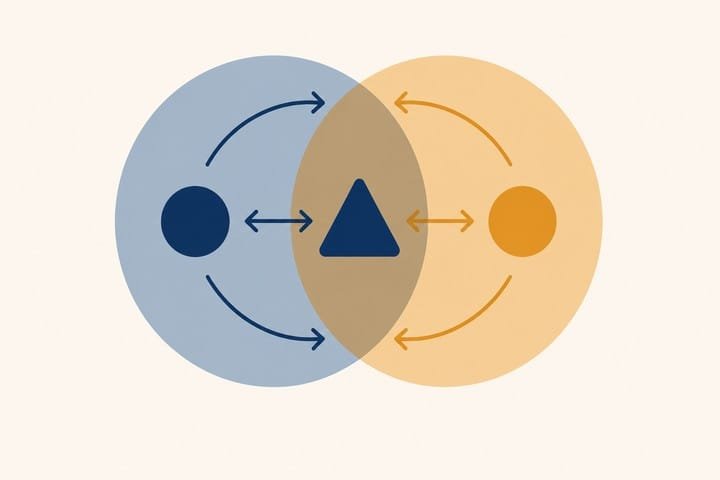
Wilbur Schramm reshaped the field in 1954 by introducing the concept of the field of experience. According to Schramm, communication succeeds only where the sender’s experience and the receiver’s experience overlap. Outside that overlap, the receiver may receive the message but not understand it.
For example, in India, where literacy levels, language differences, and access to digital technology can vary greatly from one region or community to another, the shared experiences between a national broadcaster and a rural viewer, only comfortable in vernacular language, might be quite limited. The post on the Wilbur Schramm model of communication explains the eight components in detail.
Working with Charles Osgood, Schramm also proposed a circular model. In this model, both the sender and the receiver continuously encode, interpret, and decode. There is no fixed sender and no fixed receiver, only participants swapping roles. This approach was a decisive break from the engineering tradition.
Theodore Newcomb’s 1953 ABX model added the social dimension. Two people, A and B, communicate about an object X, and their relationship shapes what they say.
Newcomb argued that communication helps to restore balance when two people who like each other disagree about something. This phenomenon is commonly observed among families arguing over a news program on television.
Bruce Westley and Malcolm MacLean adapted Newcomb’s model in 1957 for mass communication. They inserted a gatekeeper, labeled C, between the source and the audience.
C selects what passes through. To understand the situation in perspective, C is the news desk that decides which of the day’s events make it into the bulletin. The model provided a theoretical foundation for gatekeeping research.
Together, these four models shifted the focus of the discipline from mere transmission to the creation of shared meaning.
The gatekeeper idea remains relevant. In the pre-internet era of 1957, the gatekeeper used to be the chief sub-editor at a newspaper, deciding what was publication-worthy.
Today, the news app uses a recommendation algorithm, but the way it chooses content is driven more by commercial interests and remains unclear, rather than being influenced by editorial judgment or open debate.
The structural position in the Westley and MacLean model remains the same. The only change is who is occupying it.
Effects Models: Gerbner, Agenda Setting, Spiral of Silence
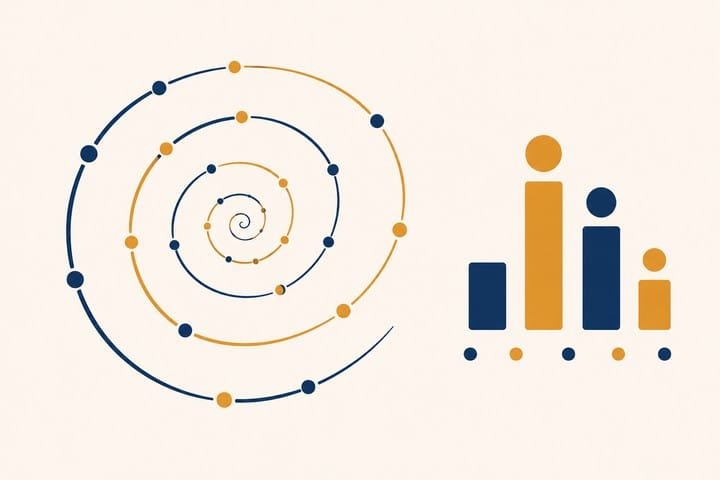
George Gerbner introduced his general model in 1956. It is unusual because it’s flexible rather than fixed. The model starts with an event, then a perceiver interprets it, and finally a statement about the event is made.
This statement then becomes an event for the next perceiver to interpret, creating a continuous and dynamic cycle.
Gerbner designed the model to be versatile, applicable from a single conversation up to a national broadcast system. His subsequent cultivation research expanded from this foundation.
Maxwell McCombs and Donald Shaw formalized agenda-setting in 1972 after studying voters in Chapel Hill during the 1968 United States presidential campaign.
Their finding was precise. Media do not tell people what to think. They tell people what to think about.
Every election cycle in India highlights this idea, as the topics that dominate prime time also become the key issues voters cite in surveys.
This connection shows how media coverage and voter concerns are closely linked, making the election process even more interesting. The post on agenda-setting theory covers the mechanism and its applications in India.
Elisabeth Noelle-Neumann proposed the spiral of silence in 1974. People scan their environment for the majority opinion and stay quiet when they believe they hold the minority view. Silence then makes the minority view look even smaller, and the spiral tightens.
Social media both proves the theory and complicates it, because algorithmic feeds distort what the majority appears to be. The post on the spiral of silence theory discusses the full argument in detail.
These three models mark a shift in the question being asked. Earlier models focused on how a message travels; effects models look at the impact of accumulated messages on society over time, helping to understand the broader influence of communication.
Gerbner’s cultivation research, which was built on his model, was tested through separate studies. He discovered that heavy viewers tend to believe that the world is more like television than actual reality. This led to the concept of mean world syndrome.
In India, the argument is usually applied to crime reporting on news channels and to the depiction of family structure in long-running serials. BARC ratings data makes viewing intensity measurable, which is what cultivation analysis requires. The detailed explanation is in the post on the cultivation theory of communication.
Indian Traditions: Sadharanikaran and the Natyashastra
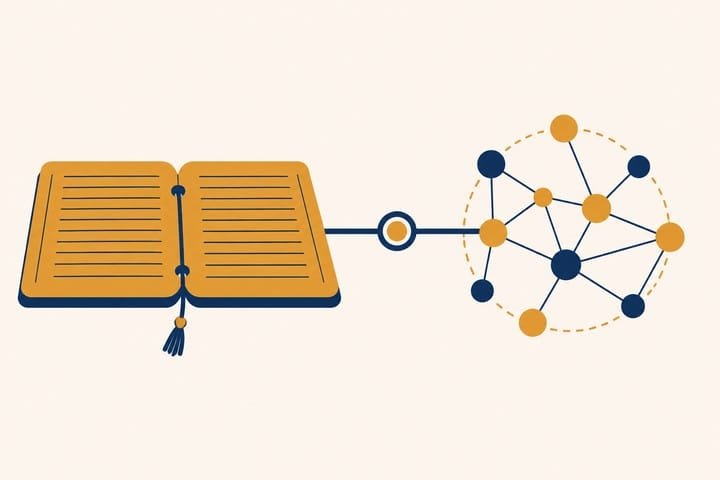
The study of communication in the Indian context goes beyond Western understanding. The UGC NET Paper II syllabus names Indian traditions and approaches to communication from the Vedic era onward. The central concept is Sadharanikaran, drawn from Bharata Muni’s Natyashastra.
The Sanskrit term describes the process by which a performer and an audience arrive at a shared emotional state. Communication succeeds when simplification and commonality are achieved, and the audience experiences rasa.
The connection of Sadharanikaran with Schramm’s model is direct and worth mentioning. Both characterize communication as generating shared understanding instead of simply delivering information.
The difference is that Sadharanikaran locates this overlap in shared aesthetic experience rather than in shared factual background.
Scholars, including I.P. Tewari, former director of the Indian Institute of Mass Communication, New Delhi, and J.S. Yadav, developed this comparison in the Indian communication literature.
The Full Model Index
Models of communication are grouped below to make the syllabus easier to navigate. Each entry is a standalone post.
Audience and influence
- Two-step flow theory. Why opinion leaders sit between the media and the public.
- Uses and gratifications theory. The reversal asks what people do with media, not what media does to them.
- Social learning theory. Bandura, observation, and modeled behavior.
- Diffusion of innovations. Rogers, adoption curves, and Indian digital examples.
Medium, meaning and ideology
- The medium is the message. McLuhan on form over content.
- Encoding/decoding model. Stuart Hall on dominant, negotiated, and oppositional readings.
- Marxist theory of media. Eight scholars from Marx to Chomsky, compared.
- Marxist literature. The key texts behind the critique.
Press systems
- Normative theory. The six theories of the press.
- Normative theories. Agenda-setting, priming, and framing compared.
- Normative theory of press. The standing criticisms of the framework.
Conclusion
Models of communication should be studied sequentially rather than learned independently. Each of these models was created because the earlier ones didn’t fully capture certain observations made by researchers.
Aristotle could not account for a mass audience. Shannon and Weaver could not account for meaning. Schramm could not account for the cumulative effect of decades of exposure.
For students preparing for the UGC NET, CUET UG, or a BA (JMC) examination, the practical advice is to learn the year, the theorist, and the single problem each model was designed to solve.
Then practice applying two or three models to the same Indian media example, such as a national health campaign or an election news cycle.
Models that fit reveal useful information, while those that do not fit reveal even more. This article works as a map, with links in each section to the detailed post on that model.
References
- Lasswell, H. D. (1948). “The Structure and Function of Communication in Society.” In L. Bryson (Ed.), The Communication of Ideas. New York: Institute for Religious and Social Studies.
- Shannon, C. E. (1948). “A Mathematical Theory of Communication.” Bell System Technical Journal, 27(3), 379–423.
- Schramm, W. (1954). “How Communication Works.” In W. Schramm (Ed.), The Process and Effects of Mass Communication. Urbana: University of Illinois Press.
- McCombs, M. E., and Shaw, D. L. (1972). “The Agenda-Setting Function of Mass Media.” Public Opinion Quarterly, 36(2), 176–187.
- Noelle-Neumann, E. (1974). “The Spiral of Silence: A Theory of Public Opinion.” Journal of Communication, 24(2), 43–51.
- National Testing Agency. UGC NET Paper II Syllabus, Mass Communication and Journalism (Subject Code 63). Official syllabus PDF, NTA.
Key Highlights
- Communication models fall into three families. Linear models move a message one way, interactive models add feedback, and transactional models treat both parties as simultaneous senders and receivers.
- Lasswell’s 1948 formulation organized the discipline. Its five elements map directly onto control analysis, content analysis, media analysis, audience analysis, and effects research.
- Indian researchers propose the Sadharanikaran model rooted in its own culture alongside the Western perspective. Drawn from Bharata Muni’s Natyashastra, it describes communication as the achievement of a shared emotional experience rather than the delivery of a message.
Recommended Reading
This is the standard Indian textbook for this paper. Covers the models in this article alongside the Indian media history that Western texts leave out, which is where UGC NET Paper II actually places its questions.
This is the reference work behind most syllabus wording on models and effects. Use it for the theoretical depth, and read it after Keval J. Kumar’s book rather than before.
Paid links. As an Amazon Associate, Indian Media Studies earns from qualifying purchases. This costs you nothing extra and does not affect our recommendations.