

This article contains affiliate links. As an Amazon Associate, Indian Media Studies earns from qualifying purchases, at no extra cost to you.
Countries worldwide are implementing social media age restrictions and safety mandates to restrict children’s use of social media. The legal and financial responsibility is also directly shifting onto tech companies.
Australia took the lead in framing legislation, passing its under-16 social media ban in December 2024. The law went into effect on December 10, 2025, covering popular platforms like Facebook, Instagram, Snapchat, TikTok, and X.
Seven months later, the United Kingdom announced its own under-16 ban, effective in early 2027. The UAE became the first Arab nation to restrict access for children under 15. Canada, Indonesia, France, and Spain announced similar restrictions.
The worldwide agreement on this issue is growing stronger. Allowing children unrestricted access to social media causes clear harm. The discussion shifted from whether to intervene to how to do it effectively.
India was monitoring developments closely. In early 2026, MeitY conducted at least three private consultations with social media firms to evaluate the technical feasibility of implementing age-based access controls.
The state governments of Karnataka and Andhra Pradesh announced their own measures on social media age restrictions. The National Human Rights Commission (NHRC) of India identified what it called “serious, large-scale, and systemic violations” committed by digital platforms widely accessed by children.
The Digital Personal Data Protection Act 2023, already enacted by Parliament, required verifiable parental consent before platforms could collect data on users under 18. But an access ban at national level did not yet exist.
For students of media studies and digital communication, this debate addresses multiple fields, linking media ethics and child psychology with platform design, data governance, and the commercial side of attention economies.
Understanding the nuances of social media age restrictions means examining the well-established problems, the debated policies, and the enforcement challenges that government has yet to resolve.
The Global Consensus on Social Media Age Restrictions
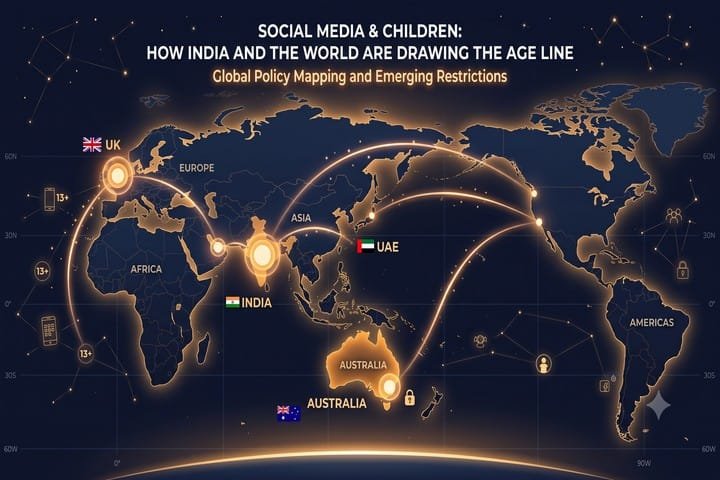
Countries worldwide began drawing lines around children’s social media use at different ages and through different legal instruments. Australia was the first to act in this direction. Its Online Safety Amendment Act, passed in November 2024 and enforced from December, set the minimum age at 16.
The Australian law placed enforcement responsibility on platforms, not on parents or children. Platforms that failed to take reasonable steps to prevent under-16s from creating accounts faced significant penalties.
The early months produced mixed results. Australian teenagers found workarounds using borrowed credentials and VPNs, and platforms struggled to verify at scale.
The UK moved in two stages. The then Prime Minister Keir Starmer announced an under-16 ban in June 2026, covering Snapchat, TikTok, YouTube, Instagram, and Facebook. Implementation was set for early 2027.
In July 2026, the UK government went further, announcing an overnight social media curfew for teenagers aged 16 and 17, applying from midnight to 6 am. The same announcement introduced a default setting that disabled infinite scroll for older teenagers.
However, users aged 16 and 17 could switch off the curfew, which was criticized for significantly reducing its practical effect. The government also announced that using AI chatbots by under-18s would trigger mandatory screen breaks.
In July 2026, the UAE became the first Arab country to set a minimum social media age. Children under 15 could not create, use, or operate personal social media accounts. They could not post content, comment on posts, join public groups, or carry out other standard social networking activities.
Teenagers in the UAE aged 15 and 16 retained access but faced additional safeguards: content controls, limits on interactions with unknown users, screen-time management tools, and parental supervision features.
Platforms were asked to comply in 12 months, build AI-powered age verification, and stop serving targeted advertising or behavioral profiling to anyone under 15.
The European Union chose a structural approach. The Digital Services Act (DSA) did not set a minimum age for social media. It required platforms to demonstrate they were not harming users.
In 2026, the European Commission charged TikTok with breaching the DSA. The commission said TikTok’s autoplay and infinite-scroll features constituted addictive design features.
It said TikTok had not adequately assessed how these features affected the mental and physical health of children and vulnerable adults. TikTok denied the charges. A non-compliance finding could result in a fine of up to 6 percent of global annual revenue.
India’s Regulatory Response on Social Media Age Restrictions
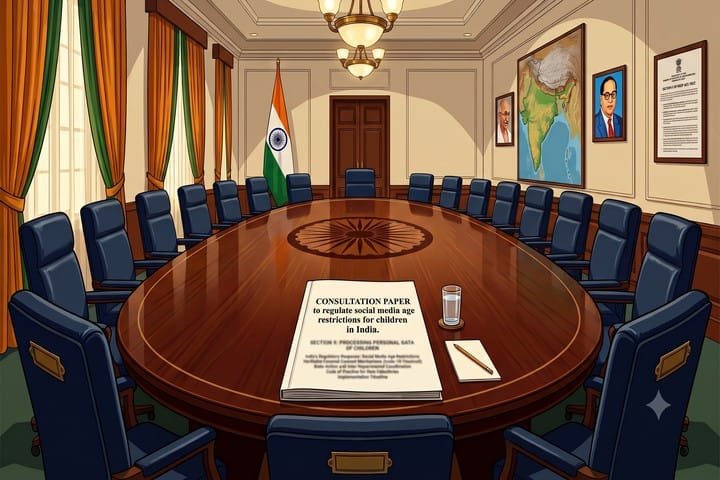
India’s national response in 2026 was consultative rather than prohibitive. MeitY held at least three rounds of discussions with social media companies to examine what age verification was technically achievable.
India currently had no age-based controls on social media access at the national level. The government is examining the Australian decision and studying outcomes from other jurisdictions before committing to a specific framework as of mid 2026.
The Digital Personal Data Protection (DPDP) Act 2023 created a legal foundation for social media age restrictions in India. The Act required platforms to obtain verifiable parental consent before processing personal data of children, defined as users under 18.
But the DPDP Act regulated data collection, not access. A platform could allow a child to create an account without collecting personal data. That gap remained unaddressed in the law as it stood.
State governments in India took a different approach from the Center. Karnataka and Andhra Pradesh both announced restrictions on children’s access to social media.
The NHRC convened a dedicated meeting with stakeholders and found serious, large-scale violations by digital, social media, ed-tech, and AI platforms widely accessed by children. It asked MeitY and several other ministries to submit action-taken reports within 15 days.
The Telugu Desam Party (TDP) Member of Parliament, Lavu Srikrishna Devarayulu, brought together 15 MPs from multiple parties to discuss the matter. Electronics and IT Minister of India, Ashwini Vaishnaw, told Parliament that there was unanimity within the parliamentary committee on the need for new steps to protect children online.
Options under active review included an outright access ban and a tiered approach that allows age-appropriate content from platforms such as YouTube and Facebook. The government had not settled the age threshold, debating whether to set it at below 13 or 16.
Social media companies warned that an outright ban could push children toward unregulated illegal channels. They argued that strong safeguards were more effective than a hard prohibition. Experts drew a parallel with online gaming, where state-level legislation proliferated before the Center stepped in with a uniform national framework.
The ASCI, which governs advertising standards in India, had separately issued guidelines restricting advertisers from targeting children in ways that exploit their developmental vulnerabilities. Those rules applied to advertisers, not to platform access.
AI Slop, Addictive Algorithms, and the Harm Hidden in Plain Sight
The EU’s concerns about TikTok go beyond just the question of minimum age. It’s not just about what content platforms host; it’s about how they’ve designed their features to encourage engagement, which regulators are increasingly viewing as potentially harmful by default.
Autoplay, infinite scroll, and algorithmically curated feeds were designed to increase time spent on the platform. The European Commission argued this constituted a structural harm that applied regardless of any age threshold.
Research highlighted particular concerns about younger users. A 2026 New York Times investigation looked into over 1,000 videos recommended by YouTube for young children, shedding light on the issue.
It found that the algorithm consistently pushed bizarre, nonsensical AI-generated videos from channels marketing themselves as educational. One version of “Old MacDonald Had a Farm” featured an animated horse hatching from an egg at 4 seconds into the video.
Dr Jenny Radesky, a developmental and behavioral pediatrician at the University of Michigan Medical School, described the core problem. She said the meaninglessness of such videos was the central issue because they were purely attention-capture.
She said the worst-case scenario was that the content was so fantastical and stimulating that it would be cognitively overwhelming for a child.
McCall Booth, a developmental psychologist at Georgetown University, said children watching such content might struggle to distinguish fantasy from reality.
In April 2026, the children’s advocacy group Fairplay wrote to YouTube CEO Neal Mohan and Google CEO Sundar Pichai. The letter was co-signed by more than 200 organizations and individual experts, including the American Federation of Teachers, the American Counseling Association, and author Jonathan Haidt.
Haidt’s book “The Anxious Generation” had documented the impact of social media on adolescent mental health. The letter called on YouTube to label all AI-generated content clearly and ban it from YouTube Kids entirely. It also called for stopping the algorithm from recommending AI-generated content to any user under 18.
Haidt’s account of how the phone-based childhood reshaped adolescent mental health is the single work most often cited in the age-restriction debate, including in the Fairplay letter discussed above. Useful background for the UGC NET Unit on media effects and audience studies.
Paid link. As an Amazon Associate, Indian Media Studies earns from qualifying
purchases. This costs you nothing extra and does not affect what we recommend.
Rachel Franz of Fairplay said YouTube’s algorithm made it impossible for young children to avoid what she called AI slop. She said such content hypnotized children and displaced the offline activities needed for healthy development.
A California jury, in a separate case, found that YouTube had designed its platform to maximize time spent by young users without adequate concern for their wellbeing. Meta faced the same finding in the same case.
India produced one early example of voluntary platform action. ShareChat’s micro-drama app QuickTV introduced PIN-based parental controls in December 2025.
The platform adopted the same content classifications used for Indian cinema: U (unrestricted), U/A 13+, U/A 16+, and A (adult). Content rated above U/A 13+ required parental controls to be activated before younger users could access it.
Ankush Sachdeva, the co-founder and CEO of ShareChat, highlighted how important it is to have clear classification, age-appropriate access, and platform accountability. He emphasized that as microdramas start to reflect mainstream themes and intensity, these measures become even more vital.
QuickTV had crossed 25 million downloads within months of launch and hosted around 350 original series. ShareChat positioned it as the first platform in India’s micro-drama segment to introduce such controls.
Why Age Bans Are Easier to Announce Than to Enforce
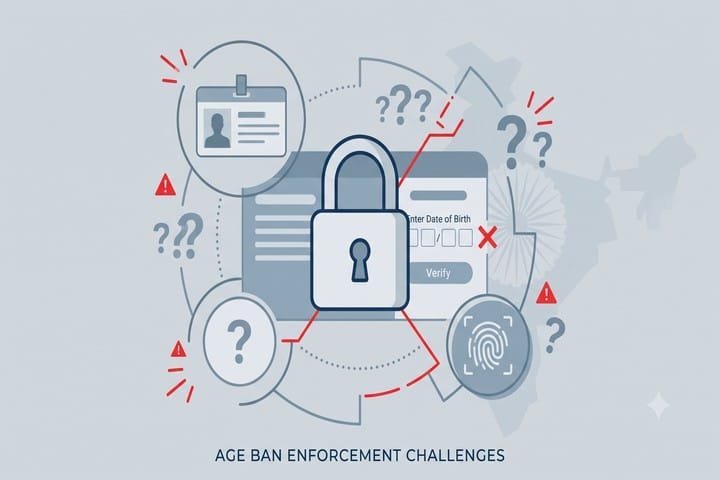
Every government proposing a social media age ban faces the same practical question. How do you prevent a 13-year-old from entering a false birthdate? The short answer is that no country has fully solved this yet.
Age verification requires platforms to collect identity data to confirm a user’s age. This creates a different problem immediately. Storing identity documents for children under 16 raises data protection and privacy risks that child safety advocates consider serious.
India’s own DPDP Act and the EU’s General Data Protection Regulation both reflect the principle that children deserve stronger data protection than adults. Requiring children to submit proof of identity to be screened out of social media directly contradicts that principle. The social media age restriction process becomes a data collection exercise targeting the very population it is trying to protect.
Circumvention is also a big challenge. Teenagers in Australia were documented using the social media credentials of willing family members or older friends. Some accessed the same platforms through VPNs set to other regions.
It was widely reported that social media age restrictions in Australia had been relatively easy to bypass. The ban produced a broader culture of workarounds among young people. That pattern, once ingrained during adolescence, might carry over into attitudes toward legal obligations in adulthood.
China’s approach offered a different model. Rather than banning access, China mandated screen-time caps for children. The state required platforms to enforce these caps directly, essentially legislating what informed parents already did through other means.
The approach avoided the age restrictions paradox but introduced its own complications. Screen-time caps still required age verification to function. They also remained susceptible to credential sharing and circumvention in societies with less regulatory reach than China’s.
The UK’s approach to teenagers aged 16 and 17 pointed toward a third path. Rather than a hard ban, the government set restrictive defaults, disabling infinite scroll and applying a midnight curfew, while allowing users to override those settings.
The UAE framework required platforms to deploy AI-powered verification and build specific safety features for 15 and 16-year-olds, rather than excluding them outright.
These tiered approaches shifted responsibility from border enforcement to product design. They required platforms to change what their services did by default, rather than simply who could access them.
Australia’s own regulator has now tested that assumption. The eSafety Commission surveyed children aged 10 to 15 in March 2026, three months after the obligation commenced. It found that 81 percent still had access to social media. Daily use barely moved, holding at roughly 58 to 60 percent before and after the ban began.
Platforms had already revoked about 4.7 million accounts belonging to Australian children by 16 January 2026. Removing accounts and removing access turned out to be different things. The platforms disputed how much weight that finding deserves.
On 14 August 2026, the local heads of Google, Meta, Snap, and TikTok appeared before an Australian Senate inquiry. Rachel Lord, YouTube’s head of government relations, argued the March data was already out of date. She told the inquiry, “It is a point in time, it’s very early on, and we caution against over-reliance on that.”
Mia Garlick, Meta’s Australian public policy head, raised a measurement objection. Accessing a platform and holding an account, she said, are not the same behavior.
Australian lawmakers remained unconvinced by the social platforms’ argument. The inquiry looked into doubling the maximum penalty to A$99 million and also considered increasing the eSafety Commissioner’s authority to request information from platforms and third-party age-verification providers.
For Indian policymakers, the sequence matters more than the verdict. Australia legislated first, enforced second, and measured third. India is still at the consultation stage, which means it can read Australia’s evidence before committing to a design. The lesson is not that age limits fail. It is that an age limit without enforceable age assurance results in revoked accounts rather than in absent children.
Conclusion
The global debate about children and social media is not ultimately about a specific age number. It is about who bears responsibility when a 13-year-old encounters an AI-generated video that distorts her sense of reality.
It is about who answers when a 15-year-old loses four hours to an algorithmically curated feed at midnight. Responsibility is shared across parents, platforms, governments, and the economic systems that reward engagement over wellbeing.
India’s response is taking shape but remains incomplete. The DPDP Act addresses data. MeitY consultations address access. State governments are acting without a national framework. What India has not yet built is a unified digital child-safety policy that covers platform design, content standards, age verification, and data rights.
Countries that have moved furthest, including Australia, the UK, and the UAE, are learning that enforcement without design reform produces limited results. India has the advantage of learning from their experience before finalizing its own approach.
The next step requires moving from consultation to an enforceable national framework. That framework must hold platforms accountable for how they are built, not just for who they admit.
References
- Digital Personal Data Protection Act 2023
- EU General Data Protection Regulation
- European Commission, Digital Services Act
- “How A.I.-Generated Videos Are Distorting Your Child’s YouTube Feed”, The New York Times, 26 February 2026
- Fairplay and more than 200 co-signatories, open letter to YouTube and Google on AI-generated content for children, March 2026
- California jury finds Meta and Google liable in landmark social media addiction trial, 25 March 2026
- eSafety Commission findings on the under-16 ban, reported August 2026
- Australian Senate inquiry evidence from Google, Meta, Snap and TikTok, 14 August 2026
Key Highlights
- Australia (legislated December 2024, in force 10 December 2025), the UK (June 2026), and the UAE (July 2026) have all enacted or announced minimum social media ages ranging from 13 to 16. India has not yet passed national legislation, but MeitY held at least three rounds of consultations with platforms in 2026, and the NHRC found serious, large-scale violations by digital platforms accessed by Indian children.
- A 2026 New York Times investigation found YouTube’s algorithm consistently recommending AI-generated, nonsensical videos to young children. A California jury found that YouTube and Meta had designed their platforms to maximize young users’ time online without adequate concern for their well-being. The children’s advocacy group Fairplay, backed by 200 organizations and author Jonathan Haidt, called for a total ban on AI-generated content in YouTube Kids.
- Age verification is the central enforcement challenge. It requires collecting identity data from the very population regulators are trying to protect. Australia’s experience showed that age-gating is easily circumvented. India’s DPDP Act 2023 addresses data collection for under-18s but does not restrict access to platforms, leaving a structural gap in India’s child online safety framework.