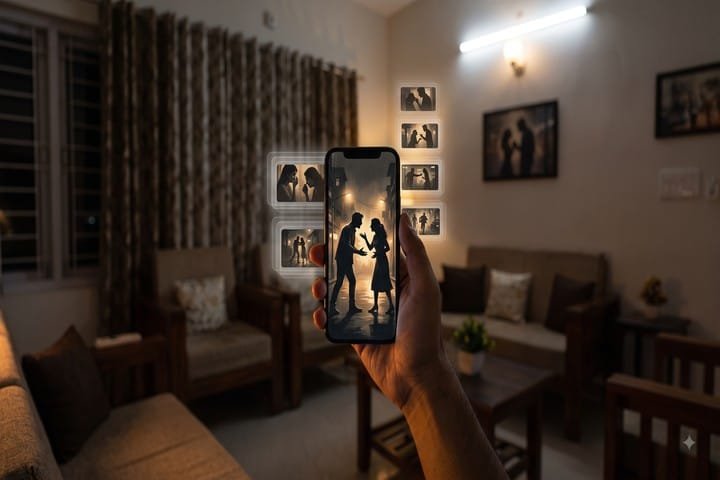
A microdrama episode typically lasts around a minute, and a complete series can include fifty or even a hundred of these compact episodes. The visuals are vertical, the cuts are fast, and nearly every episode leaves you hanging with a cliffhanger, enticing you to watch the next one.
The format combines the engaging serial nature of a soap opera with the quick, accessible style of a social feed. India is now tuning in to it in large numbers.
A 2026 study on the microdrama landscape in India by ShareChat, Moj, and Kantar found that 80% of respondents favored the format, with 86% watching for over 15 minutes each day.
More than half of the viewers returned for repeat sessions, indicating a habit rather than a novelty. Microdrama did not originate in India; it first developed in China, where vertical serialized dramas established a significant commercial market before spreading via apps like ReelShort and DramaBox.
India’s domestic platforms followed suit. In February 2025, Kuku FM introduced Kuku TV, featuring vertical episodic series with episodes lasting around two minutes and totaling fifty or more.
Studying microdrama is particularly valuable because it is still emerging, providing a fresh subject for observation. It occupies a space between short-form user content and long-form streaming, challenging several existing beliefs about attention spans, serial storytelling, and the integration of advertising into narratives.
What Microdrama Is and How It Differs from Reels and Web Series?

Microdrama is a type of scripted, serialized fiction specially designed for vertical mobile screens. Each episode is quick, lasting about 1 to 2 minutes, and the series can include dozens of episodes.
There are three key features:
- First, episodes are short enough to enjoy during a quick scroll;
- Second, the story continues seamlessly across episodes rather than being standalone; and
- Third, each episode ends on a compelling hook, making it difficult to stop watching.
This format invites viewers to keep scrolling and remain engaged.
This combination sets it apart from the two formats it lies between. An Instagram or Moj reel is usually complete in itself, often user-generated, and rarely part of a continuous story.
In contrast, a web series on an OTT platform features episodes lasting thirty or sixty minutes and is designed for horizontal, seated viewing. Microdrama combines the short length and vertical format of the reel with the narrative style of a web series.
The production economics differ sharply from conventional screen work. Series are shot in batches on fixed sets, with standardized shot patterns and edit templates, because a hundred episodes cannot be made at feature-film cost per minute. Studios view the run as a standardized process instead of a custom-made production.
The format arrived in India from outside. Vertical serialized drama scaled first in China, then traveled internationally through dedicated apps. Kuku FM entered the Indian market with Kuku TV in February 2025, offering vertical episodic series with episodes of up to two minutes and more than fifty episodes per series.
Media Partners Asia assessed the Indian market as still exploratory in its September 2025 report on the micro-drama economy, describing an ecosystem where players were testing a range of business models and distribution approaches. That assessment became outdated quickly. In less than a year, the format had grown beyond initial exploration in terms of audience, but the monetization issue it raised remained unresolved.
The scale of the format outside India explains why platforms moved so fast. Media Partners Asia recorded Chinese microdrama revenue rising from 500 million dollars in 2021 to 7 billion dollars in 2024 and expected 2025 revenue to overtake China’s domestic theatrical box office at 9.4 billion dollars.
Well over 830 million people in China watch the format, and close to 60 percent of them pay for content or transact within it. Outside China, the market generated $1.4 billion in 2024 and is forecast to reach $9.5 billion by 2030.
Vivek Couto, executive director of Media Partners Asia, characterized it as no longer a fad but a new monetization and entertainment layer situated between social media and streaming.
Two monetization models now compete in India, and they point in opposite directions. Kuku TV runs on a subscription-only model with no advertising, priced at Rs 899 a year or Rs 399 a quarter, and Kuku reports well over 10 million paying subscribers across its apps.
JioHotstar took the opposite route. It launched Tadka on 3 April 2026 as a dedicated tile within its main app, featuring more than 100 original titles with 30- to 60-second episodes in Hindi, Tamil, Telugu, and other languages, free and supported entirely by advertising.
Tadka reached 100 million users in roughly two months. Couto described it as an impressive start and highlighted questions regarding content volume, licensing, artificial intelligence, and long-term monetization.
Legacy studios have entered the format by buying stakes rather than building teams. Yash Raj Films invested in Rusk Media, and Zee Entertainment invested Rs 100 crore in the microdrama platform Bullet. That acquisition pattern and what it reveals about media ownership in India are covered separately on this site.
The naming is unsettled. Microdrama, micro-drama, vertical drama, and short drama all describe the same object.
Who Watches Microdrama in India?

The clearest audience picture available comes from the State of Microdrama in India study, commissioned by ShareChat and Moj in partnership with Kantar. The quantitative fieldwork covered 1,045 respondents across fourteen Indian cities between 4 and 25 May 2026, drawn from smartphone and social media users aged eighteen to forty-four in NCCS A, B, and C segments.
A separate attention module was run between 21 and 29 May 2026 with 450 respondents, comparing attention across microdrama, long-form content, and short-form video.
The main findings are consistent: 80% of respondents favored the format, and 86% spend over 15 minutes daily watching it. Additionally, 54% revisited for another viewing, while 77% found microdramas via social feeds rather than searching for them.
The demographic profile challenges the idea that short-form video is mainly a low-income activity. In fact, 68 percent of viewers come from households earning over ten lakh rupees annually, 63 percent own a home, and 64 percent travel more than twice yearly. The most popular storytelling category was everyday-life stories, favored by 36 percent, surpassing more dramatic genres.
Two external sources reveal additional insights. Sensor Tower reports a 113 percent increase in Indian microdrama downloads during Q1 2025, highlighting growth primarily in Tier 2 and Tier 3 cities, not just metropolitan areas.
Research from Ormax and Meta, published in March 2026, revealed that 65 percent of Indian microdrama viewers discovered the format only in the past year. This indicates that the audience is still in the early stages of developing a habit, rather than having a well-established one. It’s important to consider this context when analyzing engagement data from a single year.
The difference between watching and paying characterizes the Indian market. Myat Pan Phyu from Media Partners Asia explained that India and Indonesia generate downloads and watch time faster than any other countries, yet their paying habits remain weak and lag behind their audience engagement. This high level of engagement combined with a reluctance to pay shifts the focus from subscriptions to advertising for platforms.
Regional broadcasters are approaching the format differently. Rather than commissioning new subscription or advertising-first platforms from scratch, some are reformatting an existing content library. Sun TV Network launched Sun NXT Shorts in August 2026, a micro-drama feature inside its Sun NXT app targeting Tamil Nadu, Andhra Pradesh, Telangana, Karnataka, and Kerala.
The service opened with more than 150 titles spanning original short series, dubbed international content, and existing Tamil films and TV serials, including Endhiran and Thiruchitrambalam, re-edited into short episodic form.
Kaviya Maran, Executive Director of Sun TV Network, framed the move as an asset-reuse strategy rather than a new production bet. “We have 65,000 hours of content, decades of storytelling equity, and a distribution network that no new entrant can build overnight,” she said.
The opportunity, she added, is to take that existing asset base and reformat it for the next generation of consumption.
Sun NXT Shorts also supports the 4:3 television format alongside the standard vertical mobile format, adjusting content framing based on the device. Rakesh CK, Head of Sun NXT, described the move as a deliberate dual approach. “The same story gives you two distinct experiences, close and personal on your phone, and an expanded full canvas frame on your TV,” he said.
The approach signals a second business model beyond the subscription-versus-advertising split already seen in Kuku TV and Tadka. A broadcaster with an existing content library can enter the format at a lower marginal cost than a platform that builds original series from scratch.
The study was commissioned by two platforms that operate in the format, a standard industry practice that shapes how findings are framed. The sample is urban, drawn from fourteen cities, and restricted to existing smartphone and social media users, so it describes the behavior of people already inside the digital ecosystem rather than the general population.
Learning to state a study’s sponsor and sampling frame alongside its findings is a basic research-literacy skill, and it is frequently tested.
The Advertising Case: Brand Recall, Purchase Intent, and Narrative Integration
The commercial appeal of microdrama is based on a specific claim. The ShareChat-Moj-Kantar study found 84% brand recall and 82% purchase intent, with this format surpassing traditional short-form content on these metrics.
Neha Markanda, Chief Business Officer at ShareChat and Moj, described the shift as a microdrama evolving from an emerging format into a separate entertainment category, as audiences look for stories suited to mobile lifestyles while also offering the continuity and emotional richness of longer narratives.
The reason behind those figures is important to specify. In advertising research, engagement typically increases with attention and narrative context.
When a viewer follows a continuous story, they have an incentive to keep watching, unlike in standalone ads. Integrating a brand into this story turns an interruption into part of the context, similar to the long-standing practice of in-program placement on television.
Branded microdrama elevates this concept by turning the series into the advertisement itself. Global examples demonstrate this trend, with scripted, mobile-first series created by retailers and consumer goods companies that feature shoppable options. Indian brands are starting to explore similar formats.
Two important points are worth noting. First, brand recall and stated purchase intent are based on survey responses; they show how much attention and interest there is, but they don’t directly translate into sales. The difference between wanting to buy and actually buying has been well explored in advertising studies.
Second, the law requires transparency in advertising. The Advertising Standards Council of India asks that any paid content clearly show any connections or sponsorships.
However, making this disclosure can sometimes disrupt the storytelling, especially in narrative-driven branded content. This balance between effectiveness and honesty is a key area where ethical questions in advertising arise.
The Global Scale: What the U.S. and China Numbers Show
India’s figures differ from the global standard. In the U.S., research company Omdia projected that the microdrama format will earn USD 1.5 billion in 2025, increasing to almost USD 2 billion in 2026.
This growth contrasts sharply with the declining parent industry. The overall U.S. television market, valued at around USD 125 billion, is expected to decrease by as much as USD 15 billion each year due to ongoing cord-cutting.
The production economics explain why studios can move at this pace. A typical U.S. microdrama series runs 50 to 75 episodes, takes about three months to produce, and costs between USD 100,000 and USD 300,000 in total.
A single episode of a conventional half-hour sitcom, by contrast, costs between USD 2 million and USD 4 million. That cost gap, not audience size alone, is what allows platforms to greenlight dozens of series at a time instead of a handful.
Artificial intelligence is compressing that cost further. Inkitt’s action-focused microdrama arm, Ironblood, produces AI-assisted series for USD 60,000 or less, completed in three to four weeks.
Human writers and directors still shape the story and prompt the generative tools, and real actors train the AI on human expression. But now, instead of a reshoot, you can make revisions by editing a prompt.
India’s studios have yet to adopt AI production at this scale. The same cost pressure that produced it, high episode volume against a fixed budget, applies equally to the Indian market.
The comparison is important when looking at India’s own data. Media Partners Asia reported that Chinese microdrama revenue grew from USD 500 million in 2021 to USD 7 billion in 2024, and by 2025, it is expected to surpass China’s domestic theatrical box office, which is at USD 9.4 billion.
Against that scale, and against a U.S. market already at USD 1.5 billion, India’s platforms look like an early-stage market rather than a mature one. Kuku TV counts 10 million paying subscribers; Tadka counts 100 million users.
The rising revenue and falling production costs in both larger markets provide a more useful signal for where India is headed than either number alone.
Reading Microdrama Through Communication Theory

Microdrama fits well within several frameworks, making it a particularly useful and relevant example to include when discussing traditional theories.
Uses and gratifications theory focuses on what audiences do with media, rather than what media does to them. Microdrama provides multiple gratifications at once: a brief diversion, narrative engagement through seriality, and convenience suited to waiting times.
The high preference for everyday-life stories at 36 percent indicates a craving for personal identity gratification, as viewers see their own situations reflected on screen.
Media convergence refers to the integration of previously distinct media forms into unified platforms and devices. Microdrama exemplifies this by combining the serial format of broadcast soap operas, the vertical storytelling style of social videos, and the subscription and advertising revenue models of streaming services, all accessible on a single device.
The attention economy treats viewer attention as a limited resource that platforms are vying to capture. Cliffhanger techniques serve as a form of scarcity management, and the 54 percent repeat-viewing rate indicates its effectiveness.
Ebu Isaac, Head of Media and Analytics at Kantar South Asia, linked this trend to a broader shift in Indian digital content, in which emerging formats are more influential in capturing audience attention than traditional ones.
Agenda-setting and cultivation theory are less directly applicable but still relevant. A format centered on everyday domestic conflicts, watched daily by a large audience, accrues representational significance over time.
The ways microdrama depicts gender, family, and class remain largely unexamined, presenting a valuable opportunity for student research.
Conclusion
Microdrama entered India as an imported format and quickly became a mainstream habit. The evidence from viewers confirms the pattern: people watch daily, revisit content, and discover it through feeds rather than searching intentionally.
However, the underlying business models remain uncertain. Two contrasting approaches coexist: Kuku TV charges a subscription fee and reports millions of paying subscribers, while JioHotstar’s Tadka is free and has reached 100 million users through advertising.
The sustainability of these models will influence the types of stories funded, as subscriptions favor deeper engagement and advertising favors high volume. The strength of the format lies in its recent emergence, with its conventions still forming—making it easier to observe decision-making.
Choices about episode length, cliffhanger placement, vertical framing, and genre are deliberate rather than traditional. Watching this format develop offers insights into media industries more effectively than studying long-established ones.
Key questions include whether it can retain audiences beyond its initial novelty, whether Indian studios will produce original IP rather than adaptations, and how advertising can be integrated without undermining the trust essential to storytelling.
References
- ET BrandEquity — From reels to episodes: 80% of Indians embrace microdrama as a new entertainment habit (State of Microdrama in India, ShareChat and Moj with Kantar)
- The Hollywood Reporter — India’s microdrama market explodes as JioHotstar’s Tadka hits 100 million users
- Variety — Inside the global microdrama boom (Media Partners Asia, The Micro-Drama Economy)
- Storyboard18 — India’s micro-drama boom: a new battleground for OTT, gaming and international players
- afaqs! — Kuku FM launches vertical microdrama OTT platform Kuku TV
- ET BrandEquity — Sun TV Network launches micro-drama platform Sun NXT Shorts
- ET BrandEquity — Microdramas boom in a shrinking Hollywood as studios chase a TikTok audience (Omdia, PwC, Media Partners Asia data)
Key Highlights
- Microdrama consists of scripted vertical fiction with episodes lasting one to two minutes, totaling fifty or more installments per series. It occupies a middle ground between standalone reels and long-form web series. This format first gained popularity in China and later expanded to India through apps like ReelShort and DramaBox. Kuku FM launched Kuku TV in February 2025.
- A ShareChat-Moj-Kantar study involving 1,045 respondents across fourteen cities in May 2026 revealed that 80% preferred this format, 86% watched more than fifteen minutes daily, 54% repeatedly watched content, and 77% discovered content via social feeds. Additionally, 68% of viewers came from households earning over ten lakh rupees annually.
- The advertising case rests on survey data showing 84% brand recall and 82% purchase intent. Both measure attention and interest, not actual sales. Narrative-driven branded content also complicates disclosure. ASCI requires material connections to be disclosed, but integration keeps the story flowing, leaving no obvious place for the disclosure.
- In India, two monetization models are competing. Kuku TV operates on a subscription model priced at Rs 899 annually, with over 10 million paying subscribers. Conversely, JioHotstar’s Tadka launched on 3 April 2026 as a free, ad-supported service and surpassed 100 million users in about 2 months. Downloads and watch time significantly exceed users’ willingness to pay.
- Sun TV Network launched Sun NXT Shorts in August 2026, reformatting its existing 65,000-hour content library into a 150-plus-title micro-drama feature for South Indian audiences, supporting both mobile and 4:3 TV formats. Globally, Omdia estimated U.S. microdrama revenue at USD 1.5 billion in 2025, produced at USD 100,000-300,000 per 50- to 75-episode series, compared with USD 2-4 million per sitcom episode, with AI-assisted production pushing costs as low as USD 60,000.