This article contains affiliate links. As an Amazon Associate, Indian Media Studies earns from qualifying purchases at no extra cost to you.
What Television Advertising Is and How It Differs from Digital
Television advertising is the business of selling time. Broadcasters divide their schedules into programs and commercial breaks, then sell the seconds within those breaks to brands. In India, the standard unit is ten seconds, and everything from advertising rate cards to sponsorship tiers revolves around it.
Television differs from digital advertising in three important ways:
The first is the absence of an easy escape route. A newspaper reader can turn the page, and a YouTube viewer can click “Skip” after five seconds. Someone watching scheduled television must sit through the commercial break or leave the room. That single fact explains why the medium is priced the way it is, why it is regulated the way it is, and why brands still buy it.
The second difference is measurement. Digital advertising runs on log files, recording every impression, click, and conversion against an individual user. Television has no comparable record. Instead, viewership is measured through a sample of metered households and then projected nationwide. This is why the television rating point, or TRP rating, is so important to the industry.
The third difference is scale. According to TRAI data from December 2025, India has 335 pay channels and 576 free-to-air channels. Star Sports alone reaches more than 500 million television households, while IPL 2026 attracted 495 million television viewers across the season. No digital property in India delivers the same message to such a large audience at the same moment.
Television buys reach. Digital buys precision. Most large advertisers in India invest in both, and the interesting question is how the balance between them is shifting.
How Airtime Is Bought and Sold in India
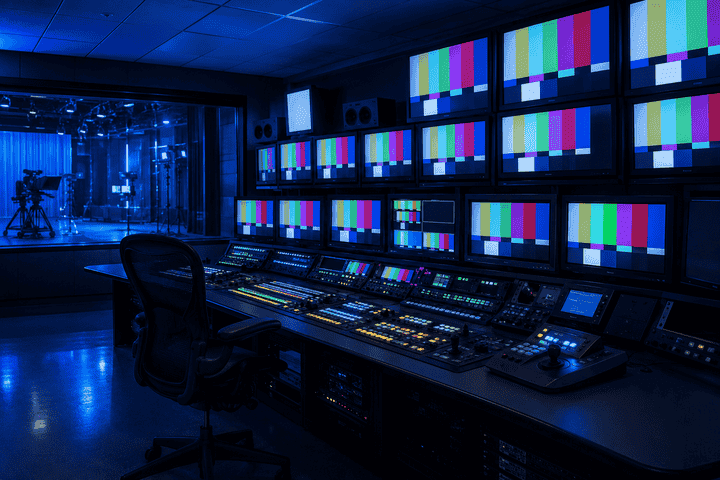
Brands reach Indian television through three distinct routes. The first is spot buying, in which an advertiser purchases individual ten-second slots within commercial breaks and selects the programs, channels, and dayparts in which they appear.
Prime time, roughly 7 pm to 11 pm, commands the highest rates because it attracts the largest audiences. Spot buying is flexible and can be withdrawn quickly, making it well suited to tactical campaigns and short bursts around a product launch.
The second route is sponsorship. Rather than purchasing individual slots, a brand attaches its name to a program or other media property. Indian broadcasters typically sell sponsorships in tiers.
JioStar’s TATA IPL 2026 structure included 27 sponsors. Google Search AI Mode, Campa Energy, Havells, and Lloyd secured co-presenting positions, while Birla Opus, Hero MotoCorp, and Amazon joined as co-powered sponsors.
Associate sponsors included Asian Paints, MRF, Flipkart, Gillette, RuPay, Amul, Groww, and Muthoot Finance. Individual tournament sponsorship packages were priced between Rs 100 crore and Rs 260 crore.
Sponsorship also extends to individual shows. During IPL 2026, Amul presented Cricket Live, while Google Search AI Mode was associated with Match Center Live.
The model is not new: Nestlé sponsored Hum Log on Doordarshan in the early 1980s, an arrangement widely regarded as a turning point in the development of Indian television advertising.
The third route is contextual integration, in which brands are incorporated into the program itself. In cricket, such integrations include DRS reviews, strategic timeouts, the toss, and post-match presentations.
Because these moments occur within the broadcast rather than during commercial breaks, viewers cannot skip them. Advertisers therefore pay a premium for these placements.
Industry commentary in 2026 indicated that spending was shifting toward contextual integrations, while rates for conventional ten-second spots remained broadly stable.
How Television Advertising Is Priced
Three terms are the most important in a television media plan.
TVR, or Television Rating, is the percentage of a defined audience that watched a program. A show with a TVR of 2 was watched by roughly 2 percent of the measured universe in that audience group. Impressions convert that percentage into actual viewers by multiplying the rating against the size of the universe.
GRP, or Gross Rating Point, is the total ratings of all ad spots in a campaign; 10 spots at 2 TVRs each sum to 20 GRPs.
CPRP, or Cost Per Rating Point, determines the advertising cost for each rating point delivered. An advertiser estimates a program’s expected TVR, applies a negotiated CPRP, and calculates the cost of a ten-second ad slot.
This explains why ratings suspensions, such as the 2026 BARC freeze during festival season, can significantly impact the market. Actual rates vary widely, and the differences are revealing.
For instance, JioStar’s IPL 2026 rate card priced a 10-second live match ad at Rs 18 lakh for combined SD and HD feeds, Rs 15 lakh for SD-only, and Rs 7.2 lakh for HD-only. The HD-only rate increased by 20% from Rs 6 lakh the previous year. An ad in the final was priced at Rs 50 lakh.
In contrast, general entertainment slots cost about Rs 1.75-2 lakh per ten seconds. In November 2025, during the Women’s Cricket World Cup final, a 10-second ad fetched up to Rs 3 lakh. The stark difference between Rs 2 lakh and Rs 50 lakh isn’t about production quality but relates to guaranteed reach, occasion scarcity, and audience engagement.
The Advantages and Disadvantages of Television Advertising
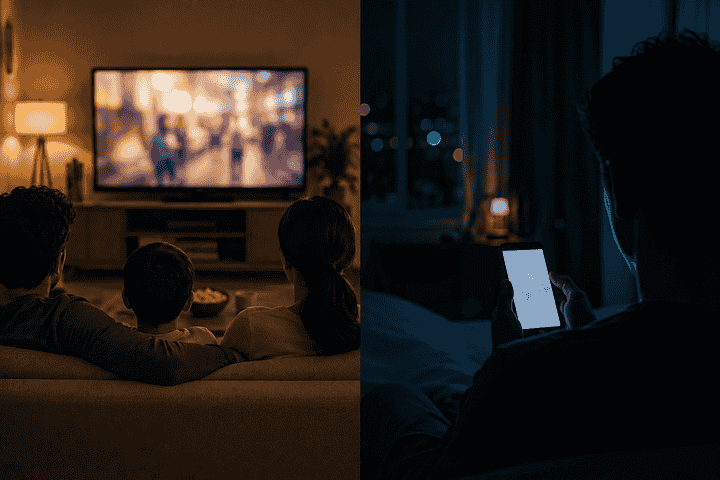
The case for television advertising rests on four main strengths.
- First, its ability to deliver mass reach remains unmatched, particularly in Tier 2 and Tier 3 markets, where smart television penetration is still low.
- Second, the combination of sight, sound, and motion allows brands to demonstrate products and tell emotional stories in ways that static formats cannot achieve.
- Third, television retains a degree of credibility. Appearing on a national channel still signals that a brand is established.
- Fourth, television creates shared cultural moments. Everybody watching a cricket tournament final sees the same advertisement at the same time.
The disadvantages are equally clear.
The entry cost is high, and a small business cannot afford a meaningful television campaign at Rs 18 lakh per slot. Targeting is also limited, as advertisers can narrow their audience only by channel and daypart. Attribution remains weak because television cannot prove that a viewer went on to buy a product.
Production adds another major expense before a single second of airtime has been purchased. Clutter is also a concern, with brands competing for attention during crowded commercial breaks, often when viewers may no longer be watching closely.
The structural disadvantage that advertisers now weigh most heavily is television’s shrinking audience. FICCI-EY recorded linear television advertising revenue at Rs 26,300 crore in net terms for 2025, a decline of more than 10 percent.
In the same year, digital advertising reached Rs 94,700 crore, accounting for 63 percent of all Indian advertising spend. TAM AdEx recorded a further 7 percent decline in television advertising volumes between January and July 2026.
It is important to understand the basis of these figures. FICCI-EY reports net revenue, while gross billings estimates for the same television market are closer to Rs 40,000 crore. This difference in measurement explains why published figures often appear to disagree.
A Short History of Television Advertising in India
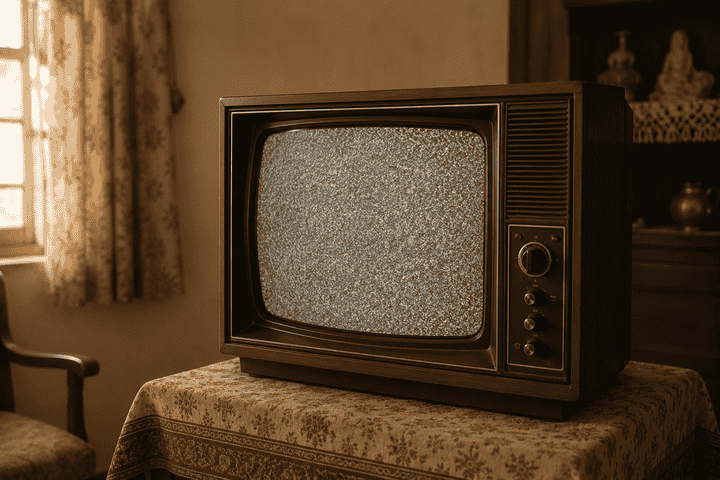
Doordarshan began as an experimental telecast on 15 September 1959 and moved to regular daily programming in 1965. On 1 April 1976, it separated from All India Radio and became an independent department.
For its first seventeen years, Doordarshan carried no advertising. It was funded through television license fees and government budget allocations. This situation changed in 1976, when the license fee was abolished, and advertising was introduced to fill the funding gap. India’s first television commercial is widely credited to Gwalior Suitings and was broadcast on 1 January 1976.
This policy shift changed programming as much as it changed Doordarshan’s revenue source. An advertiser-funded broadcaster had a reason to produce entertainment rather than focus only on instructional programming.
The 1980s established the basic character of Indian television. Color television arrived in 1982 alongside the Asian Games and national telecast.
Hum Log, the first mass-appeal television serial, introduced sponsorship to Indian television through Nestle. Hindustan Thompson Associates produced the Maggi launch commercial, which aired on Doordarshan in 1983, with Prahlad Kakkar behind the camera.
Liberalization eventually ended Doordarshan’s monopoly. Satellite channels began arriving in 1991, including Star TV and Zee. Sun TV followed in 1992 as the first private channel in South India.
A market once dominated by a single state broadcaster grew into one with hundreds of competing channels. Advertising rates also began to be determined by audience ratings rather than fixed tariffs.
Regulation followed the growth of advertising revenue. In 2006, a ceiling of twelve minutes of advertising per clock hour was introduced. It remained the subject of a thirteen-year legal challenge before the government removed it in August 2026. This important development is covered separately in our explainer on the 12 minute ad cap.
Regulation, Effects, and Advertising to Children
Three bodies oversee the process, each handling a different aspect of regulation. The Advertising Standards Council of India determines whether an advertisement is misleading, offensive, or unsafe.
The Ministry of Information and Broadcasting administers the Program Code and the Advertising Code under the Cable Television Networks Rules, 1994. TRAI regulated advertising duration until the 2026 repeal.
ASCI is a voluntary self-regulatory body, not a statutory regulator, although the Supreme Court has recognized its mechanism. Its Consumer Complaints Council investigates complaints and issues recommendations. Advertisements that fail to comply are referred to the relevant government authority.
The debate is particularly significant when advertising is directed at children. The Advertising Code prohibits advertisements that endanger children’s safety or encourage an interest in unhealthy practices.
The ASCI Code also requires that advertisements aimed at children contain nothing likely to cause physical, mental, or moral harm or exploit their vulnerability. Its guidelines further state that food advertising should not undermine parental guidance in making appropriate food choices.
The weakness lies in enforcement rather than in the way the rules are written. A 2023 review identified 13 relevant national policies, of which 9 were mandatory, and 4 were self-regulatory.
Only one, the Central Consumer Protection Authority’s 2022 guidelines on misleading advertisements, restricts the advertising of foods high in fat, salt, and sugar to children across all media.
ASCI chief executive Manisha Kapoor has publicly stated that the practical challenge, both in India and globally, is implementation rather than the absence of rules.
India has not introduced a scheduling ban like the one applied by the United Kingdom to junk food advertising. Instead, FSSAI and ASCI follow a co-regulatory arrangement in which they refer complaints about food and beverage advertising to ASCI for review.
Where Television Advertising Stands Now
According to FICCI-EY figures, linear television earned Rs 61,700 crore in 2025. This included Rs 26,300 crore from advertising and Rs 35,400 crore from subscriptions. Both revenue streams declined during the year, along with the medium’s distribution base.
The number of pay-TV households fell from 151 million in 2018 to 111 million in 2024. By 2030, this figure is projected to decline further to between 71 million and 81 million homes.
Much of the audience has shifted to connected television. Kantar found that connected television reached 166 million monthly viewers in the first quarter of 2026. More than a third of this audience could not be reached through linear television at all.
Advertising prices have followed the audience. During IPL 2026, contextual placements on connected television commanded more than Rs 21 lakh per 10 seconds, compared with Rs 18 lakh per 10 seconds on linear television.
Two regulatory developments also shaped the television market in 2026. In August, the government removed the twelve-minute advertising ceiling. This increased the amount of advertising inventory a channel could sell without creating additional demand.
Separately, the ministry suspended television ratings across all genres from 1 July, removing the measurement currency used to price airtime.
Despite these pressures, television is not finished. IPL 2026 attracted roughly Rs 5,200 crore in advertising revenue even as television ratings declined. When television can guarantee simultaneous mass reach, advertisers remain willing to pay a premium that digital cannot command.
Conclusion
Television advertising in India is a mature medium facing structural pressure, but it is not dying. It has lost advertising share to digital platforms and households to streaming services.
However, it still retains one major advantage over every alternative: the ability to deliver the same message to a very large audience at the same moment.
For students, the most useful way to understand the industry is to see how its different elements connect. Ratings determine advertising prices. Those prices determine which brands can afford the medium.
Regulation determines how many minutes broadcasters can sell and what those minutes may contain. A change in any one of these elements affects the others.
The next few years will show whether television measurement can keep pace with an audience now spread across four screens. Until the industry develops a unified measurement currency, television will continue to be priced using a panel designed for one screen, even as most viewing takes place elsewhere.
References
- exchange4media (April 2026). IPL ad rates hold steady: TV at Rs 18 lakh, CTV at Rs 21 lakh as bundled deals scale
- BestMediaInfo (February 2026). IPL 2026: JioStar holds base TV live ad rate, final at Rs 50 lakh per 10 seconds
- EY India. FICCI-EY Media and Entertainment Report 2026
- Advertising Standards Council of India. The ASCI Code for Self-Regulation of Advertising Content in India
- Dietary and food policy review (2023). Are advertising policies affirmative in restricting the marketing of foods high in fat, salt and sugar in India?
- Prasar Bharati. About Doordarshan
- Social Samosa (June 2026). TV ratings fell, but IPL 2026 still attracted Rs 5,200 crore in ad revenue
Key Highlights
- In India, advertisers buy television advertising in ten-second units through three routes. Spot buying purchases individual slots; sponsorship attaches a brand to a property in tiers; and contextual integration places brands within unskippable moments within the program.
- Pricing runs on TVR, CPRP, and GRP. A 10-second IPL 2026 live match spot cost Rs 18 lakh on the combined SD and HD feed and Rs 50 lakh in the final, compared with roughly Rs 2 lakh for a reality show slot on general entertainment.
- India’s first television commercial, generally credited to Gwalior Suitings, aired on 1 January 1976, the year Doordarshan admitted advertising after the television license fee was abolished.
- Linear television advertising stood at Rs 26,300 crore net in 2025 and fell more than 10 percent, while digital advertising reached Rs 94,700 crore and took 63 percent of all Indian advertising spend.
- ASCI self-regulates advertising content; the Ministry of Information and Broadcasting administers the Advertising Code, and enforcement rather than drafting is the recognized weakness in rules protecting children from advertising for foods high in fat, salt, and sugar.
Further Reading
This is the most detailed scholarly analysis of Indian television commercials. It offers an ethnographic view of the production process and how those choices reflect a specific vision of India. It’s particularly helpful for discussions on advertising and cultural identity post-liberalization. Keep in mind that it was published before the rise of streaming services, so focus on the cultural argument rather than market data.
A practitioner memoir from the man who led Ogilvy India’s creative work for decades. It explains why campaigns like Fevicol and Cadbury worked in an Indian idiom that imported advertising theory could not reach. The book is about craft and judgment rather than syllabus material, so treat it as background to make your exam answers less generic.
Paid links. As an Amazon Associate, Indian Media Studies earns from qualifying purchases. This costs you nothing extra and does not affect our recommendations.