
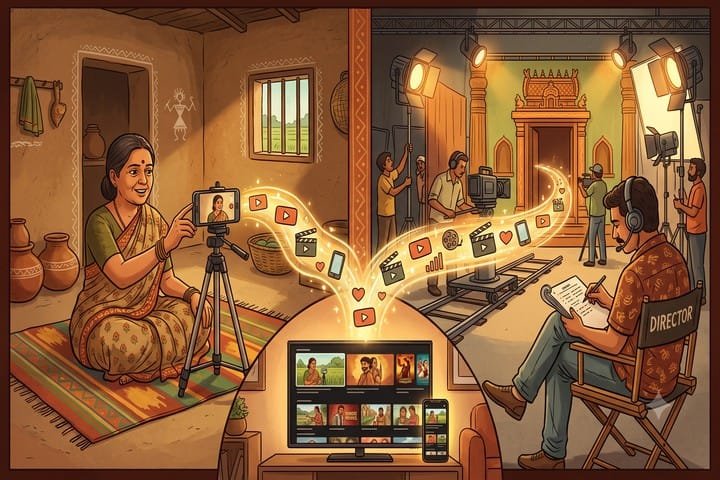
Regional-language content, especially content from the South Indian film industry, has become the dominant form in Indian media. It comprised 56 percent of OTT content in 2025, a significant increase from 27 percent in 2020. Additionally, regional cinema now accounts for over 65 percent of all films produced in India.
The FICCI-EY report, which monitors these figures, describes the shift as a fundamental change rather than a temporary one. A share doubling in five years changes who holds power in the industry.
This article is structured around three questions:
- The first concerns price: who determines the value of a regional film’s digital rights, and what are the implications if that value drops by half?
- The second question deals with ownership: when rights decrease in value, performers and writers tend to prefer taking equity in their work instead of selling their labor to others’ productions.
- The third focuses on the audience: it considers whether a creator distributes to viewers via a national aggregator or directly, and who controls the data, sets the terms, and retains the revenue.
Underneath all three sits a fourth shift that operates at individual scale. India now has between 2 and 2.5 million monetized content creators, and a growing share of them work from small towns and villages rather than metros. The Boston Consulting Group estimates they influence $ 350-400 billion in annual consumer spending.
This article explains how regional content is priced, produced, distributed, and monetized in India. It covers film acquisition economics, vertical integration in southern cinema, the aggregator problem in regional streaming, and the structure of the creator economy. Recent cases anchor each part, but the mechanics outlast them.
Streaming Economics of the South Indian Film Industry

A film generates revenue from multiple rights sold individually. The sequence begins with theatrical rights, followed by digital streaming rights, and then satellite TV rights. This sequential selling process is known as windowing, and the order is important because each buyer wants exclusivity for a specific time.
Digital rights may be sold either before or after the theatrical release, with the timing shifting the risk. Selling rights before release guarantees revenue and protects against potential box-office failure.
A platform purchasing before a film’s release takes that risk by betting on its success. In contrast, selling after the release shifts the risk back to the seller, as a hit can lead to higher prices, while a flop might not attract any buyers.
Between 2020 and 2024, Indian producers held the advantage. Platforms were competing for subscribers, so producers sold digital rights pre-release at strong prices, sometimes negotiating while a film was still shooting.
Streaming executives used to say that hits could command up to 25 percent of the total box-office collections as an acquisition fee. However, that situation has changed. Reports through 2025 and 2026 show that acquisition prices for mid-sized southern films are about half of what they used to be.
In Tamil and Malayalam cinema, the decline for large films approached 50 percent, and no Tamil film achieved a three-digit crore digital deal by mid-2026. Producer Dil Raju explained that a platform willing to pay around Rs 50 crore for a star hero’s film until 2025 was offering only about Rs 20 crore in 2026. However, falling prices do not necessarily mean platforms are leaving; instead, the volume of deals moved in the opposite direction.
An Ormax Media study revealed that nearly 60 percent of all successful theatrical films acquired by streaming platforms in 2025 were South Indian films, with 74 out of 125 titles surpassing one million admissions being from the South Indian film industry.
Netflix acquired the largest share at 34 percent, followed by JioHotstar at 19 percent, ZEE5 at 18 percent, and Prime Video at 17 percent. Investment is also continuing. JioHotstar committed Rs 40 billion, roughly 444 million dollars, over five years to southern content, with its southern entertainment head noting that viewers in southern states spend 70 percent more time on the platform.
When you look at it closely, this is more about repricing rather than retreating. Platforms are now purchasing more southern films at lower prices, showing a typical market shift from favoring sellers to favoring buyers.
The correction highlights challenges with oversupply and weaker streaming results for mid-budget titles. Many of these movies didn’t do well in theaters in 2025 and also attracted only a small audience online.
Vertical Integration in South Indian Film Industry

When the price of selling content falls, the logical move is to increase ownership of it. Vertical integration involves a company expanding into adjacent stages of the production process.
An actor who writes, directs, or produces is vertically integrating, capturing profits that would otherwise go to a studio. This is possible under two specific conditions.
The first change is a reduction in technical barriers. Previously, pursuing directing often meant a decade-long apprenticeship as an assistant, since equipment and craft knowledge were costly and closely guarded. Now, digital cameras, consumer-grade editing software, and streaming access to global cinema have shortened that learning curve.
The second is a supply gap. When performers cannot get the roles they want, writing becomes the only route to them.
Telugu cinema shows both conditions clearly. Venu Yeldandi debuted as an actor in Jai in 2004, then spent three years writing Balagam, his 2023 directorial debut, after concluding his acting career was drifting from his goals. He is now directing a second feature, Yellamma.
Adivi Sesh made his directorial debut with Karma in 2010 and has since written and starred in Kshanam, Goodachari, Major and Dacoit: A Love Story, working to make Telugu stories travel while staying culturally specific.
Naveen Polishetty moved from acting into writing after a viral web series, co-writing Anaganaga Oka Raju. Vishwak Sen has acted, written, directed and produced across Falaknuma Das, Das Ka Dhamki and Cult, and describes the logic without decoration. “It’s a necessity to create opportunities for ourselves,” he says.
He directed a film despite never working as an assistant director, instead learning from global cinema accessible through streaming. This pattern goes beyond these examples. Siddhu Jonnalagadda and Kiran Abbavaram also started writing because they couldn’t find the scripts they wanted.
There are two important changes happening in the industry.
- First, creative risk now falls more on individuals, who are now responsible for the financial risks that studios used to shoulder.
- Second, the traditional gatekeeping role is becoming less strong, since studios used to control access to equipment, funding, and distribution. They still manage funding and distribution, but no longer control access to equipment.
Aggregators and Direct-to-Consumer Regional Platforms
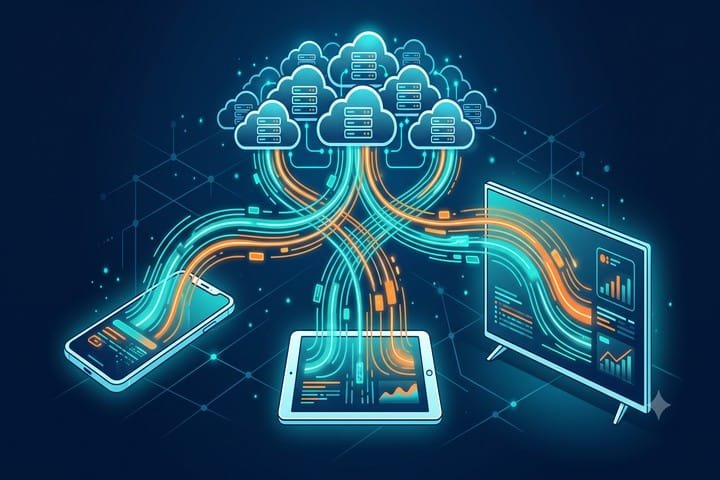
Owning content and owning the audience are different things. A regional producer whose work reaches viewers through a national platform does not know who those viewers are.
The platform manages the subscriber relationships, viewing data, payment systems, and recommendation algorithms, creating a seamless experience for everyone involved.
Producers earn either a license fee or a share of the revenue, fostering a collaborative partnership. This aggregator model is common across various media, making the process smooth and effective for all parties.
Newspapers face it with search engines and social platforms. Musicians face it with streaming services. Regional video producers face it with national OTT platforms.
In each situation, the aggregator acts as a bridge between the maker and the audience, managing the terms because it holds the demand. This naturally limits how much value can be captured.
A producer isn’t able to raise prices for viewers they can’t identify, build a subscription business with an audience they don’t own, or use viewing data to plan their next production. These decisions are made by the aggregator.
Direct-to-consumer distribution is now a viable alternative, with significant barriers reduced. Operating a streaming service previously demanded servers, encoding pipelines, content delivery networks, and specialized engineering staff, resulting in substantial upfront capital costs before acquiring any subscribers.
Cloud infrastructure transforms those expenses into a flexible running cost that grows with usage. A regional operator can easily launch an app across web, mobile, and connected TV without the need to own any hardware, making the process smoother. Similarly, a studio can simply rent rendering capacity instead of investing in building a costly render farm.
Lower barriers do not eliminate the more difficult issue. Distribution has never been the sole service provided by aggregators; they also offer discovery, marketing support, and the convenience of opening a single app instead of twenty.
A direct platform needs to generate its own demand, which costs more than fulfilling existing demand. Scale justifies this effort. In India, the OTT market exceeded Rs 272 billion in 2025, with digital subscription revenues increasing by 60 percent to Rs 163 billion. There were 216 million paid video subscriptions across 143 million households.
Multi-language strategies that include up to eight languages have become quite common. Even a regional operator with a small direct share of this market can enjoy healthy margins that a revenue-share setup might reduce.
Inside the Creator Economy: Reach, Monetization, and Payment
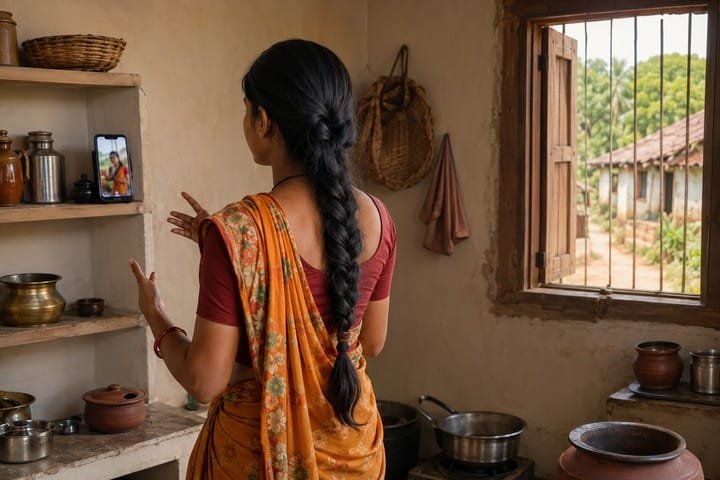
The creator economy describes individuals producing content directly for audiences on platforms they do not own, monetized through advertising, brand partnerships, subscriptions, and commerce.
Boston Consulting Group’s report on India defines a creator as someone with more than a thousand followers who produces regularly. The headline figures are significant. India has between 2 and 2.5 million monetized creators, impacting $350 to $400 billion in consumer spending each year, and is expected to influence over a trillion dollars of consumption by 2030.
Creators influence over 30 percent of purchase decisions, highlighting their significant impact. While the key numbers are important, they can make the headline a bit complex. In India, only 8 to 10 percent of creators are able to monetize their content successfully, which shows there’s plenty of room for growth.
Interestingly, about 90 percent of creators’ income comes from brand funding—like advertising and sponsorships—rather than through sales or community-based approaches.
Direct ecosystem revenues stand at 20 to 25 billion dollars. Put those together, and the picture becomes clearer: many individuals create content, but only a small fraction earn income from it. Most of this earning minority relies heavily on a single revenue stream dominated by brands and their agencies managing ad budgets.
Influence is broadly distributed. Income is not. Reach has also decentralized geographically and socially.
Pujarini Pradhan, who posts as @LifeOfPujaa, has built an audience of over 750,000 from her home in rural West Bengal, posting commentary on books, films, feminism and religion. She works in English rather than Bengali, a deliberate choice that creates distance from a local community that would otherwise judge her directly.
Her production process fits around unpaid domestic work, recorded in short windows between childcare and household duties, and edited on a phone at night. Her experience also shows where the money leaks. She has described being underpaid by an intermediary on a brand deal, which is a common problem for creators lacking legal support or agency representation.
The Advertising Standards Council of India mandates that influencers disclose material connections in sponsored content, but these disclosure rules focus on transparency with audiences rather than ensuring fairness in creator agreements.
There isn’t a framework to protect a creator if an intermediary misrepresents what a brand paid. This gap highlights the real challenge in achieving decentralization. While it’s true that creators now have access to larger audiences, their bargaining power hasn’t increased at the same pace.
Conclusion
Regional content in India has moved from the margins to the majority, and the interesting question is no longer whether it will grow. It is who captures the value it creates.
Three key insights emerge from the evidence:
- Firstly, pricing power for film rights has shifted from producers to platforms, which are now acquiring more southern films rather than fewer.
- Secondly, ownership is increasingly moving toward individual creators who assume financial risk in return for creative control, a role previously held by studios.
- Lastly, audience relationships remain concentrated with aggregators—whether a national streaming service or a social platform—because distribution has become inexpensive, but generating demand remains costly.
The Indian media and entertainment sector reached Rs 2.78 trillion in 2025, and digital overtook television as its largest segment for the first time. Regional languages carry the majority of that digital content.
Participation in Indian media has genuinely democratized. Revenue has not, and the gap between those two facts is where the next decade of industry structure will be decided.
References
- EY India — Stories, scale and impact: Unlocking India’s media and entertainment economy, FICCI-EY Report 2026
- Boston Consulting Group — From Content to Commerce: Mapping India’s Creator Economy
- Indian Broadcasting World — South Indian films claim 60% of OTT’s 2025 hit acquisitions (Ormax Media study)
- M9 News — OTT digital rights market cools as star film deals shrink
- Reuters — JioHotstar to invest $444 million in South Indian content
Key Highlights
- Regional languages accounted for 56 percent of OTT content in 2025, doubling from 27 percent in 2020, and regional cinema now produces over 65 percent of all films made in India, per the FICCI-EY 2026 report. India’s OTT market crossed Rs 272 billion in the same year.
- Digital rights prices for southern films fell sharply, with large Tamil and Malayalam titles dropping close to 50 percent and producer Dil Raju citing a fall from around Rs 50 crore to Rs 20 crore for comparable star films. Volume moved the opposite way: Ormax found South Indian titles were nearly 60 percent of theatrically successful films acquired by platforms in 2025.
- Falling rights values push performers toward vertical integration. Telugu actors including Venu Yeldandi, Adivi Sesh and Vishwak Sen now write, direct and produce their own films, capturing margin that studios once held while absorbing the financial risk studios once carried.
- India has 2 to 2.5 million monetized creators influencing 350 to 400 billion dollars in consumer spending, per BCG. But only 8 to 10 percent monetize effectively, and roughly 90 percent of creator revenue is brand-funded, so influence is far more widely distributed than income.