

Two films defined Hindi cinema in 2025-26, both sharing the same emotional core. ‘Chhaava,’ featuring Vicky Kaushal as Maratha ruler Sambhaji, was released on February 14, 2025, and grossed over Rs 800 crore.
Dhurandhar (December 5, 2025) and its sequel Dhurandhar: The Revenge (March 19, 2026), both directed by Aditya Dhar and starring Ranveer Singh, have impressively grossed over Rs 3000 crore at the box office. The Dhurandhar franchise made it onto the list of the ten highest-grossing Indian films of all time. Both movies openly showcased their nationalism and attracted huge, eager audiences.
Between those two high points, Hindi cinema had a very uneven year in 2025. Many big-budget sequels, like Salman Khan’s Sikandar, Hrithik Roshan and Jr. NTR’s War 2, Housefull 5, and others, didn’t do well after the first weekend.
The romantic drama Saiyaara, starring newcomers Ahaan Panday and Aneet Padda, collected over Rs 550 crore globally, driven by its music and storyline.
Exhibitor Vishek Chauhan described the year as a flood-and-famine situation. Either there was a flood, or there was a famine at the box office.
For students of cinema studies and media theory, 2025 brought more than just a commercial scorecard. The success of the Chhaava and Dhurandhar franchises sparked an engaging discussion about how ideology influences the world of popular entertainment.
It also raised a definitional problem. Bollywood’s patriotic movies of the past decades are also routinely considered as nationalist cinema, as if the two words were interchangeable. The box office records of 2025 and 2026 show they are not interchangeable and exactly where they diverge.
Do nationalist films succeed because they reflect a genuine public mood?
Do studios produce them because they are commercially safe?
Or does the commercial success of such films itself deepen the ideological environment that makes them possible?
These are not abstract questions. They are at the center of how film theory understands the relationship between cinema and the state.
The Nationalist Box Office Formula: Chhaava, Dhurandhar, and the Collapse of the Khan Era
Hindi cinema’s two biggest hits of 2025 shared a compelling narrative style. Chhaava drew inspiration from Maratha history, focusing on Sambhaji’s courageous resistance against the Mughal Empire.
Dhurandhar drew inspiration from covert Indian intelligence operations, depicting RAW agents confronting threats linked to the Kandahar hijack of 1999 and the Mumbai terror attacks of 2008.
Both films portray Indian identity as something they tested, defended, and preserved against external enemies. They also created significant social media buzz during their theatrical releases.
The commercial significance of these two films extended beyond their individual earnings. Kamal Gianchandani, CEO of PVR INOX Pictures, said the Hindi film business rose 10 percent in 2025 compared to 2024.
Film exhibitor Akshaye Rathi predicted a 45 to 50 percent rise in net Hindi box office collections for the year. He also forecast a 25 percent increase in young theater-goers.
The well-known Bollywood A-list did not star in either Chhaava or Dhurandhar. Vicky Kaushal and Ranveer Singh are from a younger generation than the Khan, Roshan, and Devgan group that led the industry for two decades.
Vishek Chauhan, a Bihar-based exhibitor, noted that nobody expected these films to perform as well as they did and that Bollywood had entered a new phase.
The collapse of the franchise films is equally significant. Trade analyst Taran Adarsh described War 2 as a disaster, despite expectations that it would rewrite box office records.
Housefull 5 and Son of Sardaar 2 also underperformed. Devang Sampat, managing director of Cinepolis India, argued that the real story of 2025 was not any single film; it was the depth and diversity that sustained the box office across the year.
Films like Saiyaara, Raid 2, and Mahavatar Narsimha proved that strong storytelling builds audiences over time. The data from PVR INOX’s September quarter offered a more structural reading.
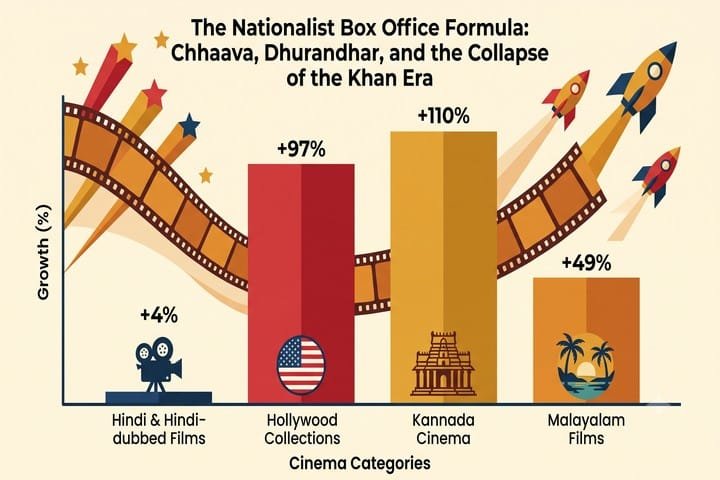
Hollywood collections increased by 97 percent, Kannada cinema revenue grew by 110 percent, Malayalam films rose 49 percent, and Hindi and Hindi-dubbed films saw a modest 4 percent increase.
Patriotic Movies, Bollywood Nationalism, and the Propaganda Debate
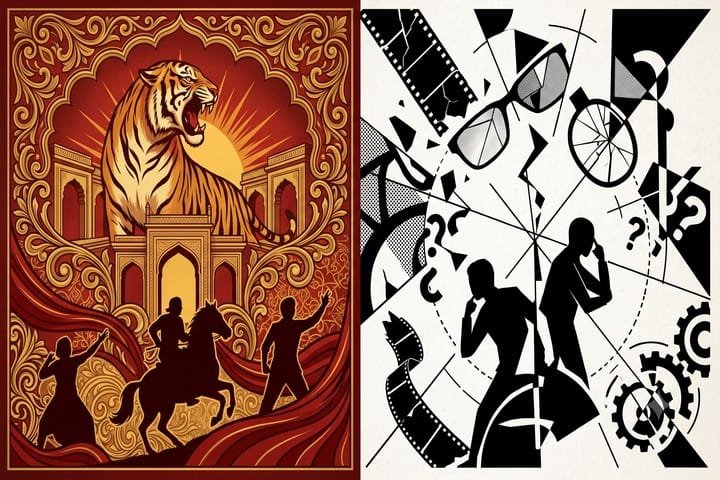
When George Orwell distinguished between patriotism and nationalism in 1945, he meant patriotism as a devotion to a particular place and way of life without any desire to force that identity on others.
Nationalism is competitive by nature: it needs a rival to measure itself against. The distinction isn’t about morality; it’s about where a film points its camera.
A patriotic film looks inward, at sacrifice, duty, grief, and the family left behind. In contrast, a nationalist film looks outward, often needing an enemy to make its message clear and meaningful.
The films released in 2026 tested this difference almost as a controlled experiment. Ikkis, Sriram Raghavan’s drama about Second Lieutenant Arun Khetarpal, the youngest recipient of the Param Vir Chakra, managed a lifetime worldwide gross of roughly Rs 35-40 crore against a reported budget of Rs 60 crore.
Ikkis was a story about the death of a twenty-one-year-old at the Battle of Basantar, his father’s grief, and legendary actor Dharmendra’s final screen performance. It also chose not to portray the Pakistani officer in an unflattering light, a decision that critics attributed to its failure. Dhurandhar, released four weeks earlier, took the opposite path and entered the all-time top ten.
The industry knows the difference, and the clearest proof is Salman Khan’s Galwan film. Announced as Battle of Galwan, a title that names a confrontation with China, it was retitled Maatrubhumi: May War Rest in Peace, combining the Hindi words for “mother” and “land” with a line that gently reflects on the sorrow of war rather than celebrating it.
Salman Khan plays Colonel B. Santosh Babu of the 16 Bihar Regiment, one of the twenty Indian soldiers martyred in June 2020.
The change reflected the shifting geopolitical reality and a desire to present the film as a reflection on sacrifice rather than as a recreation of a military event. Its April 2026 release date was pushed ahead amid reports of concern over its references to China.
The similarity between patriotic and nationalist films is as significant as their differences. Both types of films utilize common elements: the uniform, the flag, the martyr’s family, and an emotional background score as the hero falls. Both films ask the audience to believe that the nation is worth dying for. The key distinction is subtle; a patriotic film only needs the death to be meaningful, while a nationalist film requires an enemy to make that death significant.
The industry debates whether genuine creativity or commercial interests drive Bollywood’s nationalist shift. Atul Mohan, editor of Complete Cinema, said that film themes sometimes depend on prevailing political narratives, with filmmakers exploiting the nationalist wave and propaganda. However, he cautioned that this formula is unreliable, as only a few films succeed.
The contrast between The Kashmir Files and The Bengal Files supports that caution. The Kashmir Files, released in 2022, depicted the exodus of Kashmiri Pandits in 1989 and became a massive commercial and cultural event.
The Bengal Files, released in 2025 and focused on alleged political violence in eastern India, was, by Mohan’s own assessment, a commercial disaster. The subject matter was similar in ideological terms. The execution and timing were poor.
Delhi-based film critic Arnab Banerjee offered a deeper critique, stating that today’s focus isn’t on film quality but on propaganda. He noted that the prevailing national mood involves uncritical acceptance of Pakistan-bashing and references to enemy nations.
He also noted that social media hype now often determines a film’s commercial success, sometimes even without real audience support. Banerjee cited Ikkis, a film about the 1971 India-Pakistan war released in January 2026, as an example. He mentioned it was well-crafted but unsuccessful, potentially because it did not portray Pakistan as the enemy nation.
Director Ahmed Khan offered a counterargument. He said that quality ultimately determines success, regardless of genre, citing the contrasting triumphs of Saiyaara, a romantic drama, and Dhurandhar, an action-spy thriller. Both, he argued, did exceptionally well at the box office because of their quality, not their subject matter.
Dhurandhar was reportedly banned in many parts of the Middle East. Whether the ban was due to the film’s political themes or its portrayal of particular events remains a matter of interpretation.
Dhurandhar 2 and the Backlash

If Dhurandhar represented the nationalist formula working at its peak, Dhurandhar 2: The Revenge examined whether the same pattern could be repeated sustainably.
Directed again by Aditya Dhar and released in March, 2026, Dhurandhar 2: The Revenge reportedly earned Rs 1852.44 crore worldwide. These are substantial numbers by any standard.
The industry response was close to unanimous. Allu Arjun called the film “patriotism with swag” and congratulated Aditya Dhar and Ranveer Singh within hours of the first shows.
Aamir Khan expressed his endorsement as the film surpassed Rs 1,000 crore globally. Additionally, Alia Bhatt, Kangana Ranaut, Rajinikanth, Vijay Deverakonda, and Preity Zinta shared their praise.
Sidharth Malhotra called it an expression of “unapologetic patriotism with sharp geopolitical undertones,” highlighting Shashwat Sachdev’s background score and the cast, including Sanjay Dutt, Akshaye Khanna, R. Madhavan, and Arjun Rampal. Priyanka Chopra also congratulated Ranveer Singh on Instagram Stories, praising his performance.
Endorsements came in a coordinated wave across Instagram Stories and X during opening weekend, before most reviews were out and while advance bookings were still decisive. Arnab Banerjee calls this social media hype that shapes a film’s fate, ahead of or independent of the audience verdict.
Shah Rukh Khan and Salman Khan, the two biggest stars in Hindi cinema, chose not to speak out publicly. In an industry where a public endorsement can be considered a sign of political alignment, silence can say just as much as a statement, and the trade press noticed it immediately.
Dhurandhar 2: The Revenge also received its share of criticism. Kannada actor and former politician Ramya described the film as complete propaganda and urged director Aditya Dhar to move beyond jingoism.
Actor Prakash Raj expressed similar distance from the film on X, without elaborating further. Waris Pathan, spokesperson for AIMIM, called for a government ban. He said the film used real-world events such as demonetization to spread hatred. He argued it had no business being shown in India if it was causing division.
The sequel also encountered censorship delays. The Tamil, Telugu, and Kannada versions faced certification holdups, delaying their release until after the Hindi version. The Tamil and Telugu cuts reached theaters during the film’s opening week, but the Kannada version was rescheduled to March 23.
The success of Dhurandhar 2 shows that patriotic stories can still attract audiences and spark interest. At the same time, the mixed critical and political responses show that this approach isn’t always welcomed or universally appealing.
Beyond Nationalism: The Cinema India is not Watching Enough
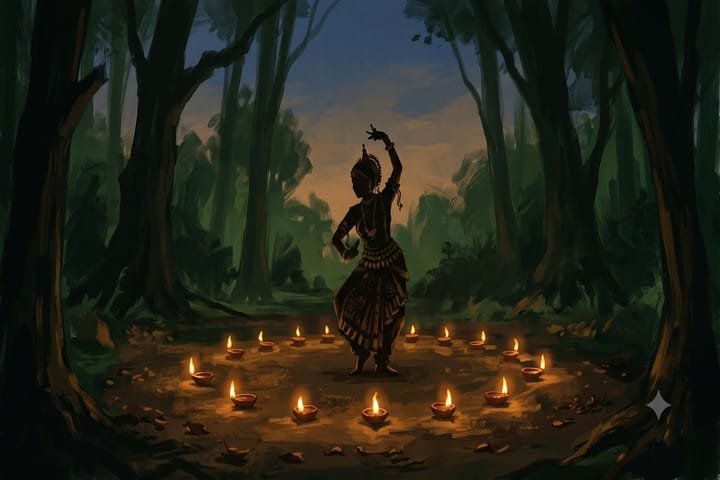
Kantara, Rishab Shetty’s Kannada-language film about forest dwellers, spirit worship, and a conflict with a corrupt landlord, was India’s second-biggest box office success of 2025. Its director described the film as a celebration of faith, culture, and devotion in their fullest form.
Kantara was not made in Mumbai. It was not primarily targeted at Hindi-speaking audiences. It was produced by a studio in Bengaluru. PVR INOX’s September-quarter data showed Hindi and Hindi-dubbed revenues rising by just 4 percent. Kannada cinema rose 110 percent, and Malayalam rose 49 percent in the same period.
This multilingual shift gently changes how audiences connect with Indian cinema. Instead of relying on a few Hindi-speaking male stars to bring blockbuster hits to a nationwide audience, the industry is now embracing a more diverse, vibrant landscape that reflects the rich variety of languages and stories across India.
Kantara, Kalki 2898 AD, and Pushpa 2: The Rule were produced in Hyderabad and Bengaluru and reached pan-India audiences through dubbing and subtitles. They succeeded not because of nationalism but because of distinctive storytelling that mainstream Hindi cinema was not offering.
Homebound, directed by Neeraj Ghaywan, offers a compelling contrast to typical blockbusters. The film was based on the true story of two young men from a village who courageously aspired to become police constables despite widespread youth unemployment.
It was India’s official entry for the Academy Award for Best International Feature Film. Ghaywan, himself a Dalit filmmaker, described the experience of caste discrimination with precision at the film’s New York premiere.
Martin Scorsese co-produced Homebound. But it struggled commercially in theaters, where audiences preferred escapist spectacle over social confrontation.
Payal Kapadia’s All We Imagine as Light won the Cannes Grand Prix and received two Golden Globe nominations for its story about two nurses from Kerala who share a room in Mumbai.
Shaunak Sen, an Oscar-nominated independent filmmaker, stated that streaming services had homogenized the industry’s worst tendencies in how they bet on films. Ticket prices have risen more than 50 percent over three years.
Amrita Pandey, the CEO of Junglee Pictures, cited Haq with Yami Gautam and the Malayalam film Ronth as examples of how audiences really connect with storytelling that puts content first.
This audience exists beyond the mainstream nationalist spectacle scene. While it might be smaller, many consider it to be the more artistically meaningful one.
Conclusion
The 2025 Hindi box-office hits Chhaava and Dhurandhar demonstrated that nationalist spectacle, executed with high production values and the right emotional triggers, can yield extraordinary commercial returns.
Industry data reveal that when Kannada cinema grows by 110 percent and Hindi by 4 percent in the same quarter, the industry’s geography of relevance is shifting.
Kantara, Homebound, and All We Imagine as Light are not fringe films. They are internationally recognized works made by Indian filmmakers who are doing something that nationalist blockbusters are not. They are telling specific, rooted, uncomfortable stories about India as it actually is.
For cinema studies students, the Bollywood 2025 moment offers a precise entry point into two long-running theoretical debates.
The first concerns cinema and ideology. Do popular films reflect dominant ideology or actively produce it? Are audiences passive recipients of political content or active interpreters?
The second concerns the economics of cultural production. Who decides which stories are made, distributed, and seen? What happens when commercial incentives and creative diversity pull in opposite directions?
References
- Deadline (January 2026). “Indian Box Office Hits Record-Breaking $1.48B In 2025; ‘Dhurandhar’ Heads Year-End Chart.”
- Sacnilk (2026). “2025 Box Office Verdict: Dhurandhar’s Double Crown, Beating Chhaava at Home and Coolie Overseas.”
- Variety (2025). “Martin Scorsese, Neeraj Ghaywan on India’s Oscar Contender ‘Homebound’.”
- Forbes (December 17, 2025). “Homebound Makes Oscars Shortlist, Eyes India’s Fourth Nomination.”
- ET Brand Equity, August 2026. Trade reporting carrying the quotes from Kamal Gianchandani, Akshaye Rathi, Vishek Chauhan, Devang Sampat, Atul Mohan, Arnab Banerjee, Ahmed Khan, and Amrita Pandey.
- Gulf News (2026). “Why Salman Khan’s war film Battle of Galwan has a new name Maatrubhumi: May War Rest in Peace.”
- Deccan Herald (July 20, 2026). “Salman Khan’s ‘Maatrubhumi’ confirmed for 2026 release; See new poster.”
- Orwell, George (1945). “Notes on Nationalism.” Polemic, London.
Key Highlights
- Chhaava and Dhurandhar were massive successes at the box office in 2025, making them two of the ten highest-grossing Indian films ever. Both films are built on nationalist themes. Both featured a younger generation of lead actors—Vicky Kaushal and Ranveer Singh—rather than the established Bollywood A-list, signaling a generational shift in Hindi cinema’s star economy.
- Film trade analyst Atul Mohan and critic Arnab Banerjee both identified a disconnect between commercial success and creative quality in Bollywood’s nationalist output. The Bengal Files failed commercially, while The Kashmir Files succeeded.
- PVR INOX data from September 2025 showed Hollywood collections rising 97 percent, Kannada cinema revenues rising 110 percent, and Malayalam films rising 49 percent—while Hindi and Hindi-dubbed films rose only 4 percent. Kantara, Homebound, and Payal Kapadia’s All We Imagine as Light represent a parallel Indian cinema that is winning international recognition even as it struggles for theatrical space domestically.