

Indian Independent Cinema and Oscar Awards
Two different systems shape whether an Indian independent film reaches a viewer. The first system determines which films are considered worthy of international recognition, while the second decides if there’s a screen near the viewer to watch on.
Media studies often view these as separate fields. Awards and festivals are usually part of film studies, while theaters and ticket sales fall under media economics. However, in reality, they are closely connected, forming two sides of the same supply chain. Currently, Indian independent cinema feels the pinch from both ends, highlighting their interlinked nature.
The film industry is built on a three-part structure that brings together producers, distributors, and exhibitors. Producers finance and create films, while distributors acquire regional rights and get films into theaters. Exhibitors own the screens and sell tickets, making the whole process work smoothly.
The flow of money, risks, and decisions is shared among these three groups through contracts. Changing these agreements can influence which movies get made, where they are shown, and whether they reach small towns or stay in big cities.
This article explores both ends of this chain. It explains how a film becomes eligible for international awards and who controls that process. It also looks at how a single-screen theater makes its money and why hundreds of Indian screens have been forced to close.
To help illustrate these points, two case studies are presented. The first is the Academy’s 2026 rule change for the International Feature category, and the second is the 2026 revenue-sharing agreement between Telugu producers and Telangana exhibitors.
How Indian Films Reach International Awards: Selection, Gatekeeping, and Festival Routes

International recognition for a national cinema does not work like a competition open to all entrants. It works through gatekeepers. For most of the Academy Awards’ history, the International Feature category admitted exactly one film per country. Each country ran its own selection committee.
In India, the Film Federation of India performs this function, choosing a single official entry each year. That design brings together a small committee with a lot of influence. People who have looked closely at the Indian process have often said that the Federation tends to favor stories that are widely accepted, rather than taking bold or politically sharp positions.
Several Indian films with strong festival records never became the official entry. The Lunchbox, directed by Ritesh Batra, premiered in Cannes Critics’ Week and was passed over. Masaan, directed by Neeraj Ghaywan, won two prizes in Cannes’ Un Certain Regard section in 2015 and was also passed over. Being celebrated abroad did not guarantee being nominated at home.
The Academy changed this design for the 99th Academy Awards. A second route now exists alongside the country submission. A non-English-language film can qualify by winning a specific top prize at one of six approved festivals.
Those prizes are the Golden Bear at Berlin, the Best Film Award at Busan, the Palme d’Or at Cannes, the World Cinema Grand Jury Prize at Sundance, the Platform Award at Toronto, and the Golden Lion at Venice.
The Academy has also taken a new approach by shifting credit itself. Now, the film is recognized as the nominee instead of the country, and the director proudly accepts the award on behalf of the entire creative team. This change comes as a response to a genuine issue.
Anatomy of a Fall won the Palme d’Or in 2023, but France did not submit it, so it could not compete in the category. Films by Iranian directors Mohammad Rasoulof and Jafar Panahi reached the category only as European co-productions, since Iran was never going to submit dissident work.
The new route doesn’t usually bring festival acclaim. It rewards six special prizes, which are awarded once a year. When you compare India’s acclaimed independent films to that list, the results can be quite eye-opening.
The Lunchbox didn’t win the Palme d’Or, nor did Masaan. Court, directed by Chaitanya Tamhane, received the Orizzonti award at Venice instead of the Golden Lion. Village Rockstars, Rima Das’s heartfelt film shot in rural Assam, earned a National Award, even though it doesn’t appear on the list.
None of those four films would meet the new criteria. The reform replaces the national committee, which acted as a gatekeeper, with a smaller international committee instead.
The Producer’s Role: Building Distribution Pathways for Independent Films

If gatekeeping explains why some films are left out, producing shows us how others find their way in. The producer’s role in independent cinema goes well beyond just organizing finances. It also involves planning festival strategies, managing territorial rights, budgeting for campaigns, and carefully planning the release order across theaters and streaming platforms.
Awards bodies don’t find films by themselves; instead, someone presents them, which often involves expense and patience. Guneet Monga Kapoor‘s career beautifully exemplifies this process. Through Sikhya Entertainment, she has supported acclaimed films like Gangs of Wasseypur, The Lunchbox, Masaan, and Kill.
She has proudly won two Academy Awards, for ‘Period: End of Sentence‘ and ‘The Elephant Whisperers.’ Her honest assessment of the industry is truly inspiring. She shares that independent cinema in India has always been a beautiful blend of vulnerability and resilience. Constant funding challenges remain, but what’s truly exciting is how, after the pandemic, audiences are now more open than ever to embracing stories from different languages and cultures.
She identifies the issue as related to positioning rather than talent or scripts. In India, festival presence, the right distribution partners, and a clear path to broader audiences are still evolving. This is an infrastructure challenge, not a creative one, and can be evaluated based on the track record.
Court won at Venice and still lacked the sustained campaign spending that converts acclaim into a shortlist place. Village Rockstars carried the National Award and India’s official submission and still lacked campaign backing.
Monga’s approach to choosing projects is truly admirable. She seeks out stories with a genuine emotional core and a unique, honest voice. She’s also supported first-time directors whose scripts might not have obvious market appeal. Her selection of projects showcases this same balance. It features the spy comedy Udta Teer with Ayushmann Khurrana and Sara Ali Khan, a Tamil film with Karthik Subbaraj designed for festivals, and a collaboration between Sikhya Entertainment and Jio Studios.
There are unique stories on one side, supported by the commercial and institutional infrastructure that brings them to life. She also emphasizes that streaming isn’t a one-size-fits-all solution. Filmmakers are exploring new ways of storytelling and making their work more accessible through digital platforms — like Nukkad Natak on Netflix, which she mentions as an example. However, she points out that hybrid and digital-first approaches are most successful when they’re underpinned by carefully built partnerships.
Exhibition Economics: How Single-Screen Theatres Make and Lose Money
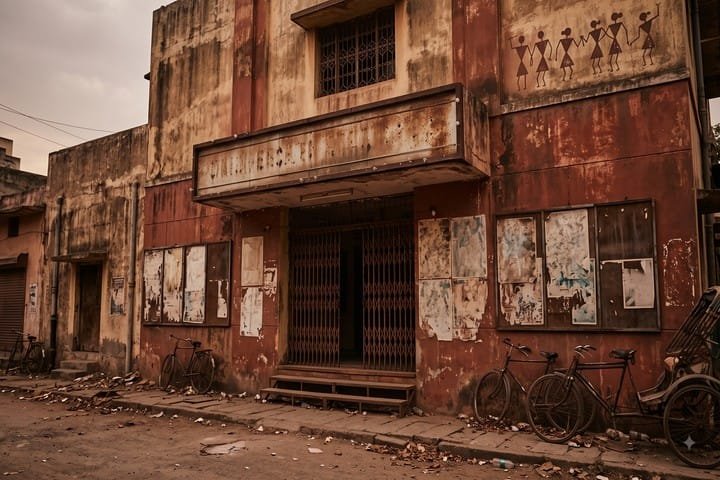
Every movie shown in a cinema is covered by a contract between the distributor and the exhibitor. In India, three main arrangements are common, and the choice among them determines who bears the risk if the film flops.
Under the fixed-hire or rental model, the exhibitor pays the distributor a set amount to screen a film for an agreed period. The amount is fixed in advance, based on the theatre’s seating capacity and location. The exhibitor pays it whether the hall fills or empties.
Under the minimum guarantee model, the distributor is assured a baseline amount, and any additional revenue beyond that is shared according to an agreed ratio.
In the percentage or commission model, the distributor and exhibitor share the actual box-office collections based on a declared ratio. Typically, the ratio favors the distributor during the opening week and then gradually shifts to favor the exhibitor as time goes on.
The economic consequence is pretty simple to understand. When a fixed hire is used, it shifts the box-office risk directly onto the exhibitor. On the other hand, percentage sharing spreads that risk between the producer and distributor, since they are the ones who selected the film and set its budget.
Indian multiplex chains usually operate based on a percentage of revenue, making their business model quite flexible. In contrast, many single-screen theaters traditionally paid fixed rents, which often limited their flexibility. Looking ahead to 2026 in Telangana, we get a clear picture of what that difference in approach has cost over time.
For decades, single-screen exhibitors across Telangana and Andhra Pradesh have been paying fixed rentals, while multiplexes have benefited from the percentage-based model, giving them more adaptability.
The Telangana Exhibitors Association explained the situation simply. Out of a total collection of one crore rupees, about seven lakh goes toward rentals for a single screen. A multiplex earns roughly forty-five lakh from percentage shares. The exhibitors kindly requested a sixty-forty split, with more proceeds going to producers and distributors.
The dispute persisted for almost twenty years before finally coming to a head in May 2026, just ahead of the release of Peddi, a big Rs 250 crore film starring Ram Charan set for June 4, 2026. Exhibitors voiced concerns about screening it, and Mythri Movie Makers, the producer, was at the forefront of opposing the change.
Vishek Chauhan, CEO of Roopbani Cinema in Bihar, described the broader situation as an existential crisis for single-screen owners, noting that exhibitors pay a fixed fee regardless of performance and have no say over which films they receive or how many shows they run.
The settlement was reached just days before the release, bringing everyone together with a spirit of cooperation. Producers and single-screen exhibitors happily agreed to shift to a percentage-sharing model, where producers and distributors would receive about fifty-five to sixty percent in the first week and about half of that in the second.
The Telugu Film Chamber of Commerce, which has been around since 1969, kindly helped facilitate this process. By the end of May, producers announced that these new terms would be in effect starting from July.
Percentage sharing was already common in Maharashtra, Karnataka, and Tamil Nadu, so Telangana was slowly catching up rather than introducing something new. The impact before the settlement was significant, with over a hundred single screens across Telangana closing in the past three years.
Global Recognition vs Domestic Infrastructure

When the two ends of the chain are joined, a pattern emerges. Reform at the recognition end is narrow and symbolic. Reform at the exhibition end is broad and material. They do not substitute for each other. The national numbers make the exhibition problem concrete.
The FICCI-EY media and entertainment report for 2026 found that only 3,150 of India’s roughly 19,500 pin codes have a cinema hall. Screen count grew by about one per cent across 2025, with 240 screens added and 124 closed; closures were concentrated among single screens.
Southern states recorded a one per cent decline against three per cent growth elsewhere. Andhra Pradesh alone lost 54 screens in 2025, and Andhra Pradesh, Telangana and Karnataka together lost over a hundred. Ormax put Telugu cinema footfalls at 18.1 crore in 2025, a second consecutive annual decline propped up at the revenue line by higher ticket prices.
Compare these figures to film supply: Indian cinemas released 1,972 films in 2025, including 270 dubbed titles. Tamil led with 315 releases, closely followed by Telugu with 313. More films are vying for a shrinking screen base, especially in the region producing most of them. This highlights the asymmetry.
A film now has the potential to go from winning at a festival to being considered for Oscar awards all on its own, without needing approval from a national committee. Each year, there are six such wins around the world, but unfortunately, no Indian film has managed to achieve this. At the same time, the cinema theatre that would show such a film to people in a district town might no longer be there, making the journey even more challenging.
Recognition reform affects only a small number of films each year, whereas exhibition economics influence every film every week across all locations. The Telangana settlement is significant because it indicates a different approach. Contract terms are negotiable, have been negotiated, and have helped stabilize a screen base that offers considerable access outside metropolitan areas.
This achievement may take longer to achieve and isn’t as noticeable as a change in Oscar rules, but it impacts many more people. Monga’s diagnosis remains valid on both ends. The main challenge for Indian independent cinema lies in the infrastructure and long-term planning, not the talent itself.
In the context of awards, this refers to campaign expenditure and festival scheduling. In exhibitions, it involves contract agreements that prevent theatre owners from shutting down. Using a single term for both underscores the importance of analyzing them together.
Conclusion
Indian independent cinema is simultaneously gaining broader international recognition while experiencing a limited domestic audience. Neither of these trends alone fully explains the industry’s current state.
The Academy’s second qualifying route is truly reformative but quite limited. Only six festival prizes annually determine the beneficiaries, and India’s most acclaimed independent films from the last decade would not have qualified under that criterion.
The exhibition side holds some significant challenges. Fixed-hire contracts shifted the box-office risk to those least equipped to handle it, leading to the closing of hundreds of screens. However, Telangana’s decision to adopt percentage sharing in 2026 demonstrates that exhibitors can successfully organize and negotiate better terms when they work together through a chamber of commerce.
It also indicates the duration, as the dispute lasted almost twenty years before settling. The firm stance combines recognition and exhibition into a single issue. Quality work merits opportunities at Cannes or the Academy, but also warrants a local single-screen theater in a district town that can afford it. A cinema recognized internationally but inaccessible locally isn’t a thriving cinema.
Key Highlights
- The Academy’s second qualifying route for the International Feature category admits non-English-language films that win one of six specific festival prizes: the Golden Bear (Berlin), Best Film Award (Busan), Palme d’Or (Cannes), World Cinema Grand Jury Prize (Sundance), Platform Award (Toronto), or Golden Lion (Venice). The Lunchbox, Masaan, Court and Village Rockstars would not have qualified, since festival acclaim alone is not enough.
- Indian distribution runs on three contract types. Fixed hire places box-office risk on the exhibitor, minimum guarantee sets a floor for the distributor, and percentage sharing splits actual collections. On a one crore collection, a single screen retained about Rs 7 lakh under rentals while a multiplex retained about Rs 45 lakh under percentage terms.
- Telangana’s single-screen exhibitors won a shift to percentage sharing in May 2026 after a dispute lasting nearly two decades, effective from July, brokered by the Telugu Film Chamber of Commerce. More than a hundred single screens in the state had closed over the preceding three years.
- FICCI-EY’s 2026 report found cinema halls in only 3,150 of India’s roughly 19,500 pin codes, with 124 screens closing in 2025 against 240 opening, and southern states declining one per cent while the rest of India grew three per cent.