This article contains affiliate links. As an Amazon Associate, Indian Media Studies earns from qualifying purchases at no extra cost to you.
The History of Indian Theatre and Who Owns It
The history of Indian theatre is usually told through its plays and playwrights. But it can also be understood through its buildings, trusts, and balance sheets. This version of the story helps explain why some theatrical traditions survived while others disappeared.
India’s theatre institutions operate under four distinct ownership models: a family memorial trust, a government academy, a village cooperative, and a venue built through public donations, some as small as five rupees.
Each model shapes what an institution can stage, how affordable its tickets are, and whether it can survive beyond the life of its founder.
This article explores these four models through four institutions before considering what they have in common.
Before the Institutions: The Classical and Folk Inheritance
Indian theatre originally did not start with physical structures. Its theoretical basis is the Natyashastra, a Sanskrit treatise on dramatic theory attributed to Bharata Muni. This work established conventions for performance, staging, and audience response that later theatrical forms continued to reference.
Alongside the Sanskrit tradition, regional folk theatres developed their own conventions across India. Some of the best-known examples are Jatra in Bengal, Tamasha in Maharashtra, Nautanki in North India, Yakshagana in Karnataka, and Bhavai in Gujarat.
These traditions brought stories directly to audiences without relying on permanent venues. They were supported either by patrons or by the audiences themselves.
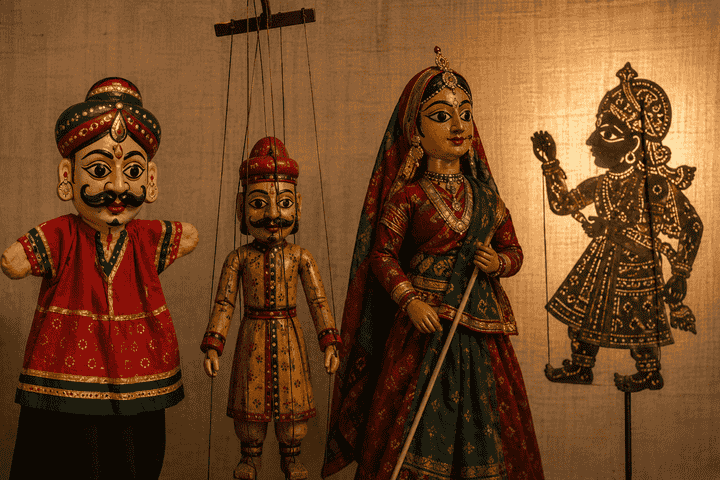
Puppet theatre belongs to the same inheritance. India’s four puppet traditions, covered separately in our guide to the types of puppetry in India, followed a similar touring model. Indian theatre companies continued to use this model well into the twentieth century.
However, touring companies had a structural weakness. Without a permanent home, a company often depended entirely on its founder’s ability to finance and manage it. This weakness explains why the first institution discussed in this article initially closed.
Prithvi Theatre: The Family Memorial Trust

Prithviraj Kapoor founded Prithvi Theatres in 1944 as a travelling repertory company. It toured India for sixteen years, staging Hindi and Urdu plays about social issues, including the aftermath of Partition and Hindu-Muslim relations.
The company never had a permanent venue. Prithviraj Kapoor supported it with his film earnings, but when his health failed in 1960, Prithvi Theatres closed. That was the end of its first chapter.
What happened next is often compressed in retellings, so the sequence is important.
In 1962, Prithviraj Kapoor leased two plots of land in Juhu, Mumbai. He planned to build the permanent home that his theatre company had never possessed. When he died in 1972, however, the theatre was still unbuilt.
The second chapter belongs to his son Shashi Kapoor and Shashi’s wife, the actor Jennifer Kendal Kapoor. They established a trust in Prithviraj Kapoor’s memory and purchased the plots he had leased.
They commissioned architect Ved Segan to design the building. Before beginning the design, Segan was sent to study theatre spaces in England and Europe.
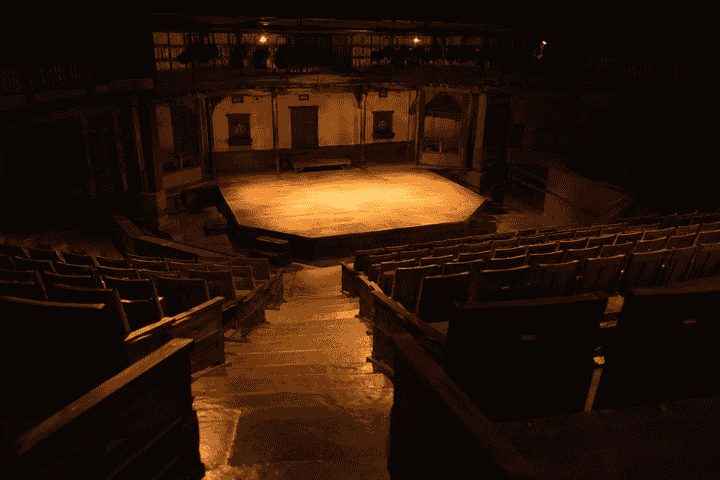
Segan worked closely with Jennifer Kapoor. Together, they developed a small thrust stage surrounded by steeply banked seating on three sides. The back row is no more than twenty-five feet from the centre of the stage, making amplification unnecessary.
Prithvi Theatre opened on 5 November 1978, eighteen years after the original company had closed.
Jennifer Kapoor managed the theatre until her death in 1984. She also started the Prithvi Theatre Festival in 1983. Her son Kunal Kapoor later took over as trustee, while her daughter Sanjna Kapoor expanded the theatre’s work into children’s programming.
The Shri Prithviraj Kapoor Memorial Trust and Research Foundation continues to operate the venue on a non-profit basis. Its stated position is that its hire charges are intended only to cover running costs.
A first-hand account of Prithvi Theatres by the man who built the Juhu theatre. It documents the touring years covered in this section, a total of 2,662 performances over 5,982 days in 112 places, and the reopening night of 5 November 1978.
Paid link. As an Amazon Associate, Indian Media Studies earns from qualifying purchases. This costs you nothing extra and does not affect what we recommend.
The National School of Drama: The Government Academy
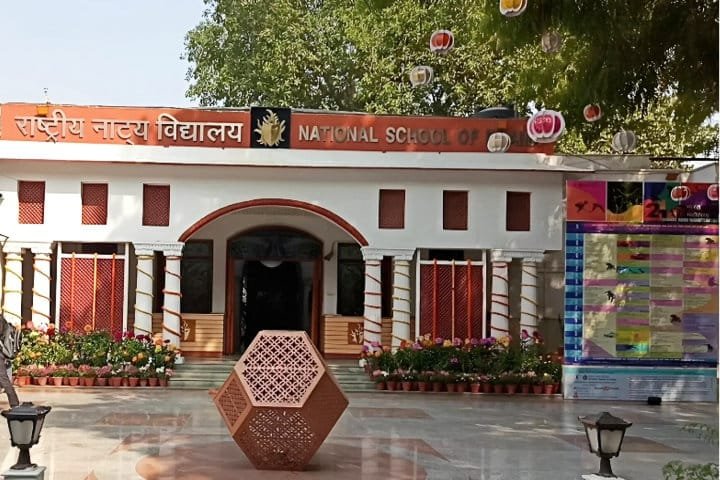
The second model is based on state funding.
The Sangeet Natak Akademi is India’s national academy for music, dance, and drama. It was established by a government resolution in 1952 and inaugurated by President Rajendra Prasad on 28 January 1953.
The Akademi established the National School of Drama in April 1959. NSD became an independent institution in 1975. It now operates as an autonomous body under the Ministry of Culture and remains fully funded by the government.
Ebrahim Alkazi directed the school from 1962 to 1977. Under his leadership, NSD became India’s leading theatre training institution.
Its professional performing wing, the Repertory Company, was founded in 1964 with four artists: Ramamurthy, Meena Williams, Sudha Shivpuri, and Om Shivpuri.
The Repertory Company provided NSD graduates with a professional platform after completing their training. This provided a structural solution to a problem that the Prithvi model did not address. The company has since staged more than 120 plays by around 70 playwrights.
In October 1989, NSD added a Theatre-in-Education Company called Sanskaar Rang Toli. It works with children between the ages of eight and sixteen.
Government funding makes this kind of long-term, non-commercial work possible in a way that ticket revenue alone would not.
Ninasam: The Village Cooperative
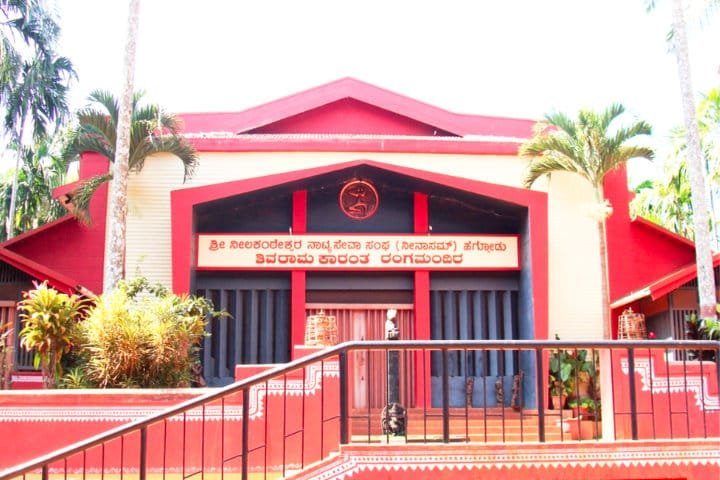
The third model is perhaps the most unexpected.
Ninasam is based in Heggodu, a village in Karnataka’s Shivamogga district, roughly 350 kilometres from Bengaluru.
It began in 1945 as an informal evening gathering where K. V. Subbanna and his friends discussed politics and current affairs. After independence, the group established a library and began producing a cyclostyled newspaper.
In 1949, it became a formal cultural organisation called Sri Nilakanteshwara Natyaseva Sangha, later shortened to Ninasam.
Unlike a family trust or a government body, Ninasam is structured as a cooperative. This distinction matters because it means the institution belongs to its community rather than to a family or ministry.
Ninasam now operates a theatre institute, a touring repertory company, a publishing arm, a film society, and an annual cultural course. Its stated aim was to create a bridge between rural and urban Karnataka.
K. V. Subbanna received the Ramon Magsaysay Award for Creative Arts, Communication, and Journalism in 1991. He died in 2005, and his son K. V. Akshara now heads the organisation.
Girish Karnad described Ninasam’s contribution in terms of the people it produces, saying that it creates people who know the vocabulary of theatre.
Ranga Shankara: The Crowdfunded Theatre
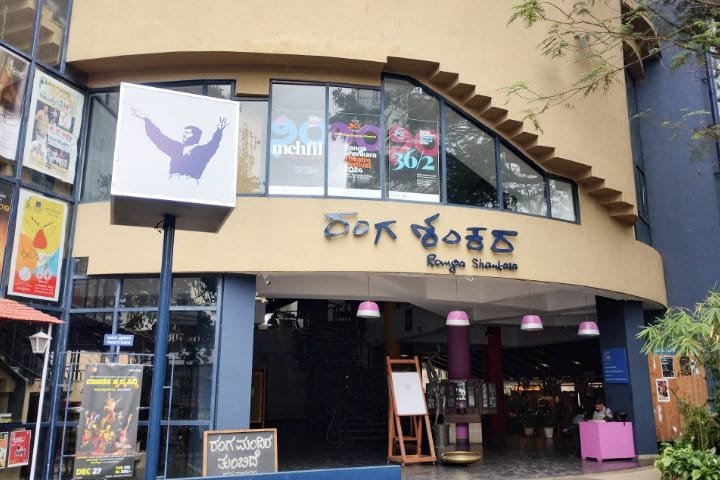
The fourth model was financed by the public.
Ranga Shankara, located in J. P. Nagar, Bengaluru, grew from Kannada actor and director Shankar Nag’s vision of an affordable and inclusive theatre space for the city.
Shankar Nag died in a road accident in 1990, before the project could begin. In 1992, his wife, the actor Arundhati Nag, established the Sanket Trust to build the theatre. Playwright Girish Karnad served as the trust’s chairman.
In 1994, the government allotted the project a plot of land in J. P. Nagar on a thirty-year lease. Construction did not begin until 2001 because the trust lacked the necessary funds.
The building cost roughly three crore rupees. The entire amount was raised through public contributions, ranging from five-rupee donations made by ordinary theatre lovers to much larger contributions from industrialists.
Ranga Shankara opened on 28 October 2004. The 320-seat theatre was designed by architect Sharukh Mistry.
The institution runs an annual theatre festival and, like Prithvi Theatre, deliberately keeps its ticket prices low.
A spin-off of Lal’s Oxford Companion to Indian Theatre, covering more than 2,000 years of Indian performance across twenty-three regional theatre traditions. It includes street theatre, Chhau, Nautanki, Kathakali, and Tagore’s plays, with over 80 photographs and line drawings.
Paid link. As an Amazon Associate, Indian Media Studies earns from qualifying purchases. This costs you nothing extra and does not affect what we recommend.
What the Four Models Have in Common
Placed side by side, these four institutions offer different answers to the same question: How can a theatre survive without depending on commercial returns?
Prithvi Theatre’s answer is a family trust supported by film earnings and sustained through inherited commitment.
NSD’s answer is a government budget.
Ninasam’s answer is collective community ownership.
Ranga Shankara’s answer is public subscription.
Each model also has a characteristic weakness. A family trust depends on the family’s continued commitment. A government body depends on political priorities. A cooperative depends on its community’s continued support. Crowdfunding can pay for a building once, but it does not necessarily pay the electricity bill twenty years later.
None of these institutions chose a purely commercial model. That is the common thread.
Serious Indian theatre in the twentieth century reached the conclusion that ticket sales alone could not sustain it. Each institution represents a different structural response to that problem.
For students of Indian media, this is the most useful way to understand them. Ownership structure is not simply an administrative detail. It determines what a theatre can afford to stage, who can enter it, and how long it can survive after its founder is gone.
Conclusion
The history of Indian theatre runs from the Natyashastra and regional folk traditions to a group of twentieth-century institutions that had to create their own funding models.
Prithvi Theatre, the National School of Drama, Ninasam, and Ranga Shankara were built, respectively, by a film family, a ministry, a village, and a public subscription drive.
None of them was created to make money, and all four are still operating.
Most of the touring companies that preceded them are not.
That contrast shows why institutional structure, rather than artistic merit alone, belongs in any account of how Indian theatre survived.
References
- Prithvi Theatre. “The Theatre.” Official website, prithvitheatre.org.
- National School of Drama. “About the Repertory Company.” Official website, nsd.gov.in.
- Sangeet Natak Akademi. “About Us.” Official website, sangeetnatak.gov.in.
- Encyclopaedia Britannica. “National School of Drama.”
- “Ninasam,” “Ranga Shankara,” “Sanket Trust,” and “K. V. Subbanna.” Wikipedia, The Free Encyclopedia.