

When a film gets tangled in political pressure or censorship in India, the financial stakes are never small. A delayed release, a forced re-edit, or a restrictive certificate can shift a big-budget film’s revenue by tens of crores overnight.
Film censorship in India is governed by the Central Board of Film Certification (CBFC) under the Cinematograph Act, 1952. The law is meant to balance free expression with public order. But in practice, its day-to-day operation often decides whether a film opens on schedule or sits unreleased for months.
For students of media studies and mass communication, it is important to understand where constitutional law, box-office economics, and industry practice collide directly. Two current examples show the stakes. Vijay’s Jana Nayagan has seen its release delayed. Salman Khan’s Maatrubhumi has reportedly been directed to delete China-related references and reshoot 40% of the film.
This raises a real question. Do political or diplomatic sensitivities, such as film certification decisions or law-and-order concerns, actually act as barriers in the industry? These factors can delay projects, limit distribution, or force costly edits that hit everyone along the chain, from producers to exhibitors.
This article covers the legal rules around film certification, how censorship disputes are financially analyzed, the key cases filmmakers look to, and whether controversy ever truly boosts a film’s success at the box office.
Legal Framework of Film Certification
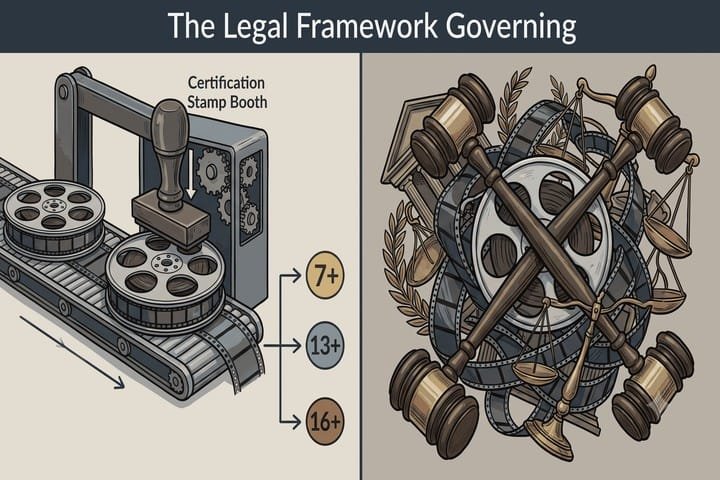
Any discussion of censorship risk has to start with the law. In India, films can only be shown in cinemas after they receive approval from the CBFC, a statutory body established under the Cinematograph Act of 1952. On examination, the Board may:
- Sanction a film for unrestricted exhibition
- Restrict it to adult audiences
- Direct cuts or modifications as a condition of film certification
- Refuse film certification altogether
The Cinematograph (Amendment) Act, 2023 split the earlier ‘UA’ category into three age bands: UA 7+, UA 13+, and UA 16+. Certificates now carry perpetual validity. And the Central Government’s revisional power over the Board has been formally removed.
Film Certification, however, isn’t a free hand. Section 5B of the Act ties the Board’s authority to the same reasons that can limit free speech under Article 19(2) of the Constitution. These include the sovereignty and integrity of India, the security of the State, friendly relations with foreign countries, public order, decency, morality, contempt of court, defamation, and incitement to an offense.
The ‘friendly relations with foreign states’ and ‘public order’ clauses are exactly what come into play with China-related references or other sensitive political content. But the constitutional test is strict. Any restriction needs a clear and direct connection to these reasons. It cannot rest on uncertain or distant fears of causing offense.
One structural change materially affects how filmmakers can respond to an adverse decision. Until 2021, a producer aggrieved by a certification decision could appeal to the Film Certification Appellate Tribunal (FCAT), a specialist, low-cost, quick forum with industry members.
The Tribunals Reforms Act, 2021, abolished the FCAT and replaced ‘Tribunal’ with ‘High Court’ throughout the Act. This change matters. Issues that once got settled in a few weeks now have to go through writ jurisdiction. That means higher legal costs and the constant worry that a film sits unfinished “in the can” while the legal process plays out. The delay itself can cause commercial damage.
Political Pressure, Censorship Risk, and the Commercial Impact

Two major productions illustrate the immediate facts. Vijay’s Jana Nayagan, which was scheduled to release in theatres on January 9, 2026, ahead of Pongal, was only released on July 23, 2026. Salman Khan’s Maatrubhumi is reportedly being modified to remove China-related references and reshoot about 40% of the film.
These cases show how political and diplomatic sensitivities, like film certification results or law-and-order concerns, become real commercial hurdles. They can delay exploitation, limit distribution, or force content changes. Each of these hits cash flow along the producer-distributor-exhibitor chain.
Fact patterns in Indian film censorship disputes typically fall into three buckets:
- Non-release/withholding of a completed film
- Compelled alteration — cuts, redubs, reshoots, or disclaimers
- Constrained release — delay, reduced screen counts, or a restrictive certificate
Jana Nayagan, Satluj, Udta Punjab, Kissa Kursi Ka, and The Interview illustrate this range. The financial impact can include lost theatrical revenue, duplicated printing and advertising costs, extra completion expenses (edits, reshoots, VFX, redubbing, re-certification), financing carry costs, and losses from piracy or demand shifts during a delay.
The numbers involved are substantial:
- The Jana Nayagan delay was reported to translate into an INR 100 crore loss for Tamil Nadu theatre owners.
- Where a film is directed to cut politically sensitive references and reshoot a substantial portion, reported at 40% in Maatrubhumi’s case, the producer bears material incremental completion and re-marketing cost exposure.
- Director Lokesh Kanagaraj publicly stated that Coolie accepted an ‘A’ certificate rather than 35 cuts. He said the restriction corresponded to an estimated INR 40–50 crore reduction in box office potential.
In a high-budget film, even a slight delay, a more restricted film certification, or small additional expenses can shift the revenue forecast by tens of crores. Financiers and distributors also factor in the ongoing uncertainty as a “political/certification risk premium.” This can lead to self-censorship in scripts and marketing before a film even releases.
Put plainly, the financial impact of film censorship in India is driven less by the controversy itself than by what the controversy does to the release calendar and the distribution footprint.
A film that premieres on time can often withstand certification discussions. A delayed release cannot. It loses the momentum of its opening weekend. It loses festival and holiday windows. And it loses much of its theatrical appeal to piracy and alternative demand before it even hits the screen.
Legal Recourse: What Filmmakers Do When Censorship Strikes

Filmmakers are not without remedy. When political pressure or censorship threatens a release, producers typically pursue a layered strategy:
1. Exhaust the certification process: Follow the CBFC’s review and revision procedures. Where possible, suggest specific adjustments and aim to secure film certification or re-certification quickly to reduce ongoing expenses.
2. Pursue legal remedies: When film certification is denied, cuts are excessive, or state authorities effectively ban a film, producers often turn to the High Court or Supreme Court under Article 19(1)(a) of the Constitution. Speech should not be limited just because it might cause offense. Any restriction must meet constitutional standards, including a clear link to preventing public disorder.
3. Mitigate pending resolution: Producers can make small, targeted changes: disclaimers, age restrictions, adjusted release dates, or distribution planning outside theaters where it makes sense. These steps help protect revenue while the dispute plays out.
4. Build in pre-emptive risk controls: Producers now build legal approvals, careful fictionalization, and clear disclaimers into the process early. This helps prevent injunctions or delays before they start.
When a State Government tries to stop a film that’s already been approved, it must show a real and immediate danger. Courts have made this clear: once the CBFC approves a film, the state’s job is to maintain law and order and allow the film to be shown, not to give troublemakers a free pass to disrupt it.
For producers facing regional bans or pressure to withdraw voluntarily, acting quickly to protect their investment is usually the best option. A production company planning a nationwide release should build in legal checks, rights clearances, fictionalization, disclaimers, and a film certification plan from the start.
Doing this upfront helps producers avoid legal hurdles. It also makes the project easier to defend if legal action becomes necessary, especially in urgent cases before higher courts.
Does Controversy Ever Help?
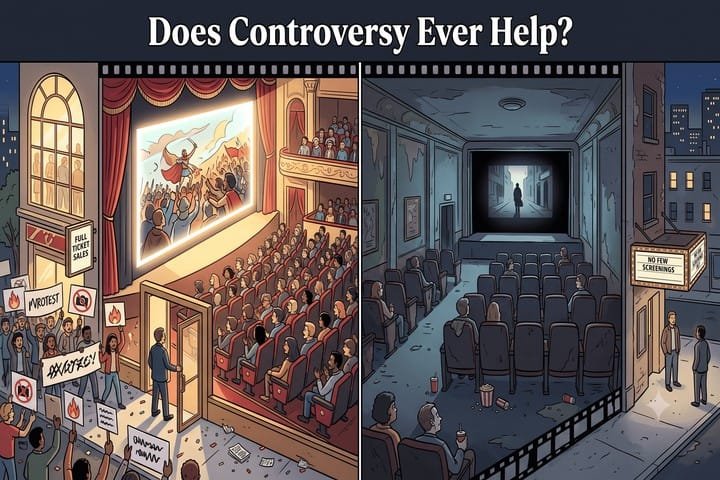
Controversy can boost a film’s visibility and, sometimes, its commercial success. But this only holds if distribution stays unaffected. When controversy raises awareness without disrupting the release, it can work in the film’s favor. Padmaavat (2018) faced protests and regional disruptions, yet still achieved a domestic gross of around INR 571–572 crore.
But when controversy causes real distribution problems, like delays, fewer screens, or a strict certificate, the impact tends to turn negative.
Coolie’s ‘A’ certification, accepted instead of 35 cuts, was linked to an estimated revenue shortfall of INR 40–50 crore. Director Lokesh Kanagaraj said as much himself.
The pattern is consistent. Awareness alone does not translate into box office gains if a film’s actual reach stays constrained. Screens, showtimes, and release windows all matter more than headlines. Publicity from controversy is, at best, a marginal offset against the much larger costs of delay, forced alteration, or restricted distribution.
Building Compliance Into the Business of Filmmaking

Specialist legal practices now advise producers, studios, and distributors across the full lifecycle of film censorship and certification in India. This starts with front-end script vetting, rights clearances, and fictionalization strategy. It continues through CBFC certification and re-certification. And it extends to urgent writ remedies when a certificate is refused, or a state-level restriction threatens a release.
Production houses increasingly treat this legal support as a core commercial function, not an afterthought. Their release calendars and recoveries depend on it. Building compliance in early protects both the content and the underlying economics of a release.