
CTV Advertising Introduction
For decades, Indian television advertising ran on one currency: reach. Buy the highest-rated show, maximize Gross Rating Points (GRP), and hope the spend translates into sales. That equation is breaking down.
Connected TV (CTV), the internet-enabled viewing of streaming content on television screens, has moved from an experimental line item to a core part of India’s media plans within a single year. Wimbledon 2026 drew 25 advertisers and 21 categories to CTV, more than double the count on linear television for the same tournament.
The FIFA World Cup 2026 pulled in categories that historically avoided premium sports broadcasting altogether. At the same time, agency executives are openly rejecting completion rates and GRPs as sufficient measures of success, arguing that attention, audience quality, and business outcomes now matter more than raw scale.
Media companies are restructuring too. Zee Entertainment recently unified its broadcast and digital advertising revenue functions under one leader, a signal that advertisers increasingly buy audiences across platforms rather than individual channels.
For students of media economics and advertising, this moment offers a live case study in how a distribution technology reshapes pricing, measurement, and organisational design all at once.
The following sections trace three connected developments: the data showing CTV’s expanding advertiser base, the shift in how sponsorships get priced, and the structural changes inside media companies responding to a converged video market.
CTV Pulls In a Wider Advertiser Base
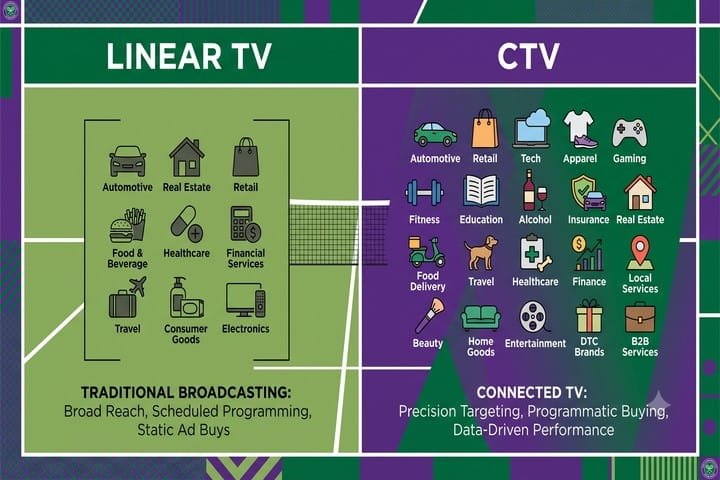
TAM Sports Adex data from Wimbledon 2026 shows the clearest evidence yet of CTV’s expanding reach. Star Sports carried the tournament on linear television in India, while JioHotstar streamed it as CTV.
CTV featured 21 advertising categories and 25 advertisers, versus 9 categories and 10 advertisers on linear television, even though linear ad volumes themselves rose 30 percent over Wimbledon 2025.
Mutual funds led spending on both platforms, but the categories diverged sharply beyond that. On CTV, liquor, cars, tyres, and watches followed mutual funds. On linear television, tiles and floorings, watches, lubricants, and smartphones rounded out the top categories.
William Grant & Sons India topped CTV advertiser rankings with a 9.7 percent volume share, while ICICI Prudential Asset Management Company led linear television at 8.7 percent.
Timing matters as much as platform choice. During the FIFA World Cup 2026, television advertising volumes in India fell 14 percent, largely because late-night kick-off times reduced advertiser participation. Premium content alone does not guarantee ad spend. Viewing habits and scheduling still decide outcomes.
Despite that decline, LV Krishnan, CEO of TAM Media Research, pointed to improved audience measurement and cross-screen analytics as the drivers of CTV’s next growth phase.
At the Brand World Summit 2026, marketers went further, agreeing that CTV has crossed from an experimental budget line into a standard, mandatory component of media planning. The debate has shifted from whether to invest in CTV to how much of the video budget belongs there.
Sponsorships Move From Reach to Results

As CTV scales, the way marketers value premium inventory is changing just as fast. Trishul Bhumkar, managing partner at Zenith India, argues CTV cannot be treated as just another digital channel bought on CPMs. It functions as a premium content environment where programming quality and viewing context matter as much as targeting precision.
Anil Suryavamshi, vice president of digital for South and West India at Carat India, describes the new measurement framework as three layers: delivery, quality, and outcome.
Delivery metrics like impressions and completion rates are now table stakes, not differentiators. “Completion validates delivery but decides nothing,” Suryavamshi said, adding that marketers who still lead with completion rates are reporting, not measuring.
Quality metrics such as attention and co-viewing carry more weight, and campaign renewals increasingly depend on measurable business outcomes including brand lift, search behavior, and sales.
This has changed how media gets bought. Bhumkar says the industry is moving from buying programs to buying the right audiences within the right content environments.
Suryavamshi sees two parallel strategies emerging: large tentpole sponsorships around premium live events, and always-on programmatic audience buying, both run under a single measurement layer. For challenger brands, this shift opens new doors.
Nikhil Doda, co-founder and COO of Lahori Zeera, says brands now ask which audience they want to influence rather than which show has the highest ratings.
His company’s “Sip Kar, Pitch Kar” integration during Shark Tank India Season 5 (Sony LIV / Sony Entertainment Television) shows the trend toward native storytelling over simple logo placement. “Brands today want to be part of the story, not just sponsor it,” Doda said.
Why CTV Still Can’t Be Measured Like Television
For all the growth in advertiser participation and pricing sophistication, CTV in India still lacks the one thing that made linear television plannable at scale: a common, third-party measurement currency.
Arindam Paul, chief business officer at Atomberg, laid out the problem in an interview with ET BrandEquity. Twenty to twenty-five years ago, he explained, television was a single mass medium on a single screen, and marketers could spend a fixed sum and reliably reach a fixed audience.
Today, that same rupee buys less: “If you simplify it, earlier you could spend Rs 100 and reach 100 people. Today, that Rs 100 has effectively become Rs 200, while the number of people you can reach may have reduced to 50. You are paying more to reach fewer people.”
The core issue, Paul said, is that television has BARC as a shared currency, but there is no equivalent for digital video: no third-party measurement that tells an advertiser the overlap between a YouTube viewer and a JioHotstar viewer, or between an Amazon Prime Video viewer and another OTT platform’s audience.
ACR and OEM-level data from television manufacturers such as LG and Samsung can describe what happens on a single device, but “they don’t give you a combined picture,” he said — there is still no equivalent of BARC that combines reach and frequency data across every platform an advertiser buys on.
In the absence of that currency, Paul said advertisers are left building their own heuristics: picking the largest reach-building platform, such as YouTube, targeting 70-80 percent of its addressable universe, then moving to the next-largest platform, accepting that overlap will inflate frequency beyond what any single platform reports.
Frequency itself has become harder to control on CTV than on traditional TV, where FMCG brands could once monitor exactly where and how often their ads appeared; on CTV, delivery is personalised and real-time, making external validation difficult — a problem Paul noted has worsened even in sports advertising as inventory has shifted from spot-based to CPM-based selling.
Despite the measurement gap, the money keeps moving: Paul said some large advertisers are now allocating roughly 30-35 percent of video budgets to CTV and about 30 percent to linear TV, evidence that CTV is increasingly viewed as a replacement for television itself rather than merely an extension of HD channels.
The shift has also lowered the entry barrier for smaller advertisers, who can now target a specific geography or audience segment on CTV without having to buy an entire market the way linear television historically required.
Paul’s recommended fix in the absence of an industry-wide currency is control-and-test market experimentation: activating CTV in one market, measuring the uplift, and correlating it with market share and brand-tracking data to build proprietary models over time — a discipline he expects will define which advertisers scale CTV investment successfully and which merely spend on faith.
Streaming Platform’s Share of CTV Ad

India’s CTV measurement gap is unfolding against a global backdrop of platforms scaling their advertising businesses aggressively, and Netflix is the clearest example of why that competition is intensifying.
According to WARC Media forecasts cited in a platform insights report, Netflix’s advertising revenue exceeded USD 1.5 billion in 2025, about 3.3 percent of its total revenue, and the company aims to double that figure to USD 3 billion in 2026 before reaching USD 8 billion by 2030, according to data from Omdia.
Netflix is targeting competitor market share rather than relying purely on overall market expansion, and WARC Media’s global CTV advertising spend data shows the company on track to grow its share of worldwide CTV ad spend from 3.7 percent in 2025 to roughly 9.2 percent by 2027.
Celeste Huang, media insights analyst at WARC Media and author of the report, said Netflix is “expanding beyond video into a global entertainment hub,” increasingly attracting ad dollars on the strength of live sports, cultural events, Gen Z’s affinity for brand integrations, and a reputation for trustworthiness among both brands and viewers.
That trust matters commercially: advertisers rank Netflix the fourth best-perceived “trustworthy” global platform behind YouTube, Instagram, and Google, according to Kantar data, and Netflix stands out for strict content curation compared with user-generated-content platforms.
Gen Z audiences are 70 percent more likely to trust brands that engage with their favourite fandom shows and 74 percent more likely to buy from brands aligned with those fandoms, per Ipsos Global Influentials data cited in the report.
This is a global, not an India-specific, trend — Netflix’s largest ad categories in the US, per Sensor Tower data for Q2 2025, are shopping, consumer packaged goods, financial services, travel and tourism, and telecoms — but it matters for Indian media planning for a structural reason: as global streaming platforms scale their ad businesses and compete more aggressively for the same premium CTV inventory categories that Wimbledon and FIFA World Cup data show Indian advertisers are also chasing, the pressure to solve India’s own measurement gap only grows.
A market without a shared currency is harder to defend against well-funded, globally scaled competitors who are already winning ad dollars through trust and content quality rather than price alone.
Media Companies Reorganize for Converged Video

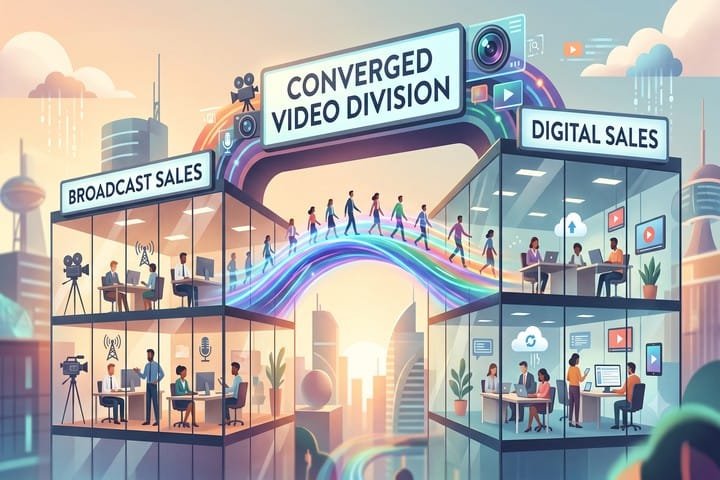
The clearest signal of CTV’s maturity may not be a data point at all. It is an organizational chart. Zee Entertainment appointed Prashant Shetty to lead both broadcast and digital advertising revenue under one unified role, ending the traditional split between linear TV sales teams and digital sales teams.
This restructuring reflects how advertisers now think about buying. They increasingly purchase audiences that move across screens, not fixed inventory tied to a single channel. Industry commentary around the move frames it directly.
The future sales conversation is no longer broadcast versus digital. It is unified video. This mirrors what agencies describe on the buying side. India’s fragmented identity ecosystem remains a challenge for audience-based buying.
Even so, the direction is set. As FIFA World Cup 2026 CTV data shows, categories that historically avoided premium sports broadcasting are now participating, and streaming is expanding the total advertising pie rather than simply moving television rupees online.
For India’s ₹40,000 crore television ad market, already under pressure from a weekly ratings suspension disrupting measurement, CTV’s growth offers both a new revenue stream and a new set of planning problems that linear-only teams were never built to solve.
Why This Matters for Media Planning in India
Four insights follow for students and working professionals tracking India’s media economy.
First, CTV is not cannibalizing linear television budgets. Wimbledon 2026 saw linear volumes rise 30 percent even as CTV attracted a wider advertiser base, and FIFA World Cup CTV data shows new categories entering premium sports advertising altogether.
Second, measurement is now a competitive differentiator, not a back-office function. Agencies that still report completion rates as their headline metric are, in Suryavamshi’s words, reporting rather than measuring, while brand lift and business outcomes increasingly decide contract renewals.
Third, the absence of a shared measurement currency for digital video is not a minor technical gap — it is, as Arindam Paul argues, the central constraint shaping how every advertiser, large or small, has to plan CTV spend today, forcing even sophisticated marketers back onto heuristics and control-test experiments rather than reliable third-party data.
Fourth, organizational structure follows strategy, and so does global competition. Zee’s decision to merge broadcast and digital revenue leadership under Prashant Shetty shows that unified video planning requires unified sales teams, while Netflix’s climb toward nearly 10 percent of global CTV ad spend by 2027 is a reminder that Indian broadcasters and streamers are not just competing with each other for advertiser budgets, but with globally scaled platforms that have already solved parts of the trust and content-quality equation.
For a country with fragmented audience identity systems and a television market still recovering from a ratings-measurement disruption, these shifts will define which media companies and agencies capture the next wave of advertising growth.
Conclusion
Connected TV’s rise in India is not a single story about streaming stealing television’s audience. It is four stories happening at once: an advertiser base that is genuinely expanding, a measurement framework that is being rebuilt from the ground up, a persistent currency gap that even sophisticated advertisers have not solved, and a global platform economy racing to capture the same ad dollars India’s own broadcasters and streamers are fighting over.
Wimbledon 2026 and the FIFA World Cup 2026 both demonstrate that timing, platform, and content quality now interact in ways linear-only planning never had to account for.
Agencies like Zenith India and Carat India are pushing clients toward outcome-based evaluation, while advertisers like Lahori Zeera are choosing native integration over traditional sponsorship logos.
Arindam Paul’s account of building reach through heuristics and control-test experiments shows just how much of this work still falls on individual advertisers rather than a shared industry currency.
Meanwhile, Zee’s unified revenue leadership under Prashant Shetty and Netflix’s climb toward nearly a tenth of global CTV ad spend both suggest the same conclusion from different directions: the industry’s next competitive battles will be fought not just over content, but over who can measure and sell audiences across every screen at once, in a market where global platforms are no longer optional competition to plan around.
For India’s ₹40,000 crore television advertising market, still absorbing a ratings-measurement disruption, CTV represents both an opportunity and a test of whether legacy sales structures can adapt fast enough.
References
- CTV attracts wider advertiser mix during Wimbledon 2026
- CTV Moves to the Centre of the Media Plan
- How streaming is repricing the value of sponsorship
- Streaming isn’t just changing where people watch. It’s changing what brands pay for.
- CTV is becoming a replacement for television, but measurement remains a challenge
- Netflix is set to take nearly 10% of global CTV ad spend next year
Key Highlights
- CTV hosted 25 advertisers and 21 categories during Wimbledon 2026, more than double linear television’s 10 advertisers and 9 categories, even as linear ad volumes rose 30 percent over the previous edition.
- Agency executives including Anil Suryavamshi of Carat India and Trishul Bhumkar of Zenith India say sponsorship value now rests on attention, audience quality and business outcomes, not GRPs or completion rates alone.
- Zee Entertainment unified broadcast and digital advertising revenue under Prashant Shetty, signaling that Indian media companies are restructuring sales teams around converged, cross-platform audience buying.
- Arindam Paul (CBO, Atomberg) says India’s video ecosystem has no BARC-equivalent measurement currency across platforms, forcing advertisers to build their own reach heuristics; large advertisers are now allocating roughly 30-35% of video budgets to CTV.
- Netflix’s ad revenue is on track to reach USD 8 billion by 2030, with its share of global CTV ad spend projected to grow from 3.7% in 2025 to about 9.2% by 2027 (WARC Media), intensifying global competition for the same premium ad inventory Indian platforms are chasing.